As cannabis is legalized and products containing cannabis compounds like THC and CBD become more accessible to the general public, scientists have sought to fill knowledge gaps regarding the effects of cannabinoid exposure on human health. A research team from the University of Alberta (U of A) examined the impact of prenatal cannabinoid exposure by measuring the neural activity of zebrafish exposed to the compounds as embryos.
The researchers left zebrafish embryos to incubate for 10 hours in a solution containing either THC, CBD, both or a control, immediately after fertilization. The solutions were designed to mimic a human consuming cannabis or its active compounds every day for 2-3 weeks at the beginning of pregnancy.
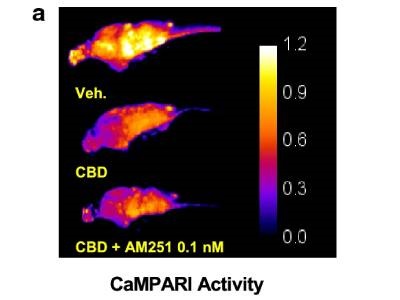
Researchers used the fluorescing calcium indicator CaMPARI to observe neural activity on the fourth day of development, and found that activity decreased by 60-70% in the group exposed to THC and by more than 70% in the group exposed to CBD. The group exposed to both compounds showed an even more pronounced drop in neural activity.
Locomotion was also measured on the fifth day after fertilization, and reduced by about 20% in the group exposed to THC or CBD individually, and 80% or more in the group exposed to both. The study was published in Scientific Reports.
“The interesting part is when combined, like how it is found in a cannabis edible or cigarette, we needed much less to get the same reduction in neural activity,” said Richard Kanyo, post-doctoral fellow at U of A and lead author of the study.
The findings have implications for prenatal exposure in humans, and the researchers said prospective parents should limit cannabis and cannabinoid consumption during pregnancy.
Photo: CaMPARI heat maps of zebrafish larvae exposed to CBD and CBD with the CB1R- inhibitor AM251 compared to a control. AM251 did not fully rescue the neural activity of larvae exposed to CBD. Credit: Kanyo, R., Amin, M.R., Locskai, L.F. et al. Scientific Reports. CC BY 4.0. Cropped from original.