Biomedical engineers at Duke University have demonstrated that a class of interwoven composite materials called semi-interpenetrating polymer networks (sIPNs) can be produced by living cells.
Traditional methods for manufacturing sIPNs typically involve producing the constituent parts called monomers and mixing them together in the right chemical conditions to control their assembly into large networks in a process called polymerization. In the new paper, Zhuojun Dai, a former postdoc who is now an associate professor at the Shenzhen Institute of Synthetic Biology, uses a platform that the lab has been developing for several years, called "swarmbots."
Swarmbots are living cells that are programmed to produce biological molecules within their walls and then explode once their population reaches a certain density. In this case, they're programmed to produce monomers called elastin-like polypeptides (ELPs) fused to functional features called SpyTag and SpyCatcher. These two molecular structures form a lock-and-key system, allowing the ELPs to self-assemble into a polymer chain when mixed. As they grow, these polymers entangle themselves with the polymeric microcapsules containing the cells to form sIPNs.
Each monomer can contain multiple SpyTags or SpyCatchers and can also be fused to proteins that generate a readout or have specific functions. It's sort of like making a chain-link fence out of many tiny charm bracelets that have room for clasps and charms.
"Nobody has used living cells as a factory to produce monomers in real-time for sIPNs before," said Lingchong You, professor of biomedical engineering at Duke. "The proof-of-principle demonstration shows that, not only can we fabricate these types of functional materials with live cells, but they can exhibit medically relevant functions."
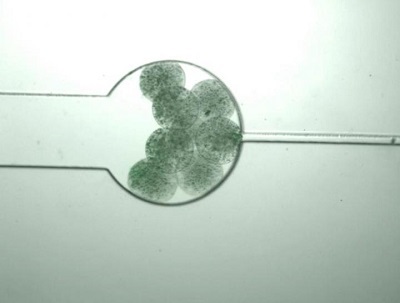
Photo: Swarmbots, living cells engineered to produce monomer molecules, grow until they sense their population density has reached a certain level, whereupon they burst open, allowing the monomers to mingle and self-assemble into a composite polymer. Credit: Zhuojun Dai