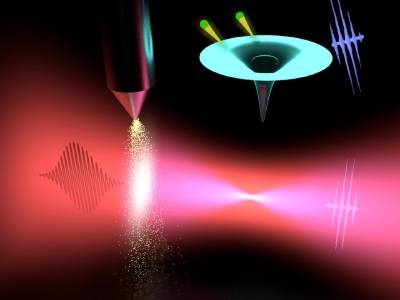
Extreme ultraviolet (XUV) lasers allow for advanced nanoscale imaging and attosecond physics experiments not possible with traditional light sources. The application of XUV lasers has been limited due to the facility space needed to accommodate the most intense XUV sources. Scientists at the Max Born Institute (MBI) recently designed a compact, intense XUV laser using a novel high harmonic generation (HHG) technique.
While existing intense XUV lasers based on HHG have used a gas medium placed at the focus of a near-infrared (NIR) beam, the MBI team placed a high-pressure gas jet farther away from the beam’s focus. At this position, a large XUV beam with a large divergence is generated, which can be focused to a small spot size and generate intense XUV pulses. Because this method does not require the NIR laser to have a very large focus, the setup could be confined to a footprint of just two meters.
The intensity of the pulses generated with this technique were confirmed by computer simulations performed by ELI-ALPS and INCDTIM researchers, and demonstrated through multiphoton ionization of argon atoms resulting in charge states of Ar2+ and Ar3+. The results were published in the journal Optica.
The new concept could be used for various applications, such as imaging of biomolecules and observation of electron dynamics at extremely short timescales. The compact design could also help overcome the stability limitations of advanced techniques like attosecond-pump attosecond-probe spectroscopy.
Photo: An NIR pulse (red) is focused, and high harmonics are generated in a gas jet that is placed before or behind the NIR focus. In this way, the generated XUV light has a size and a divergence that is similar to that of the NIR beam. Due to the shorter wavelength, the focus of the XUV beam is then much smaller than the focus of the NIR beam. This allows the generation of intense XUV pulses which are used for XUV multi-photon ionization of atoms (see upper part). Credit: Balázs Major