Greenhouse gases and air pollutants can be detected with a variety of sensors and monitors, but few with the range and precision to monitor large open areas for multiple gases simultaneously. The National Institute of Standards and Technology (NIST) previously developed a near-infrared (IR) dual-comb spectroscopy (DCS) system to simultaneously measure methane, carbon dioxide, water vapor and air temperature, but the system was not sensitive enough to also detect nitrous oxide, ozone and carbon monoxide in the open air. Now, NIST has unveiled a new open-path DCS system using mid-IR light, which simultaneously measures nitrous oxide, carbon dioxide, water vapor, ozone and carbon monoxide. Together with the near-IR system, all four primary greenhouse gases can be detected.
A frequency comb system uses ultrafast lasers to emit a continuous train of closely-spaced femtosecond pulses, which span the entire spectrum of visible light and create evenly-spaced frequency peaks that resemble the teeth of a comb. These evenly-spaced peaks serve as an ultra-precise “ruler” for measuring the exact frequencies of light. NIST’s work helped push the wavelengths generated from frequency combs further into the IR range. The new dual-comb system split the near-IR light from one comb into two branches, used fibers and amplifiers to broaden and shift the spectrum of each branch, and then recombined the differing branches in a crystal of periodically poled lithium niobate (PPLN) to produce mid-IR light through difference frequency generation.
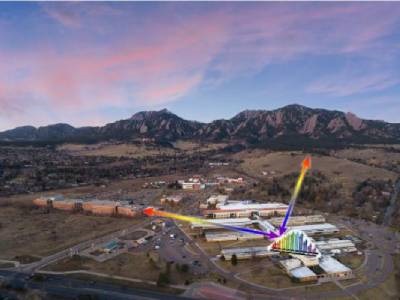
The mid-IR system was demonstrated over two round-trip paths, one spanning 600 meters and one spanning 2 kilometers. The light from the frequency combs was transmitted from a telescope at the top of a NIST building in Boulder, Colorado. For the shorter range, the light was transmitted to a reflector on the balcony of another building, and for the longer range, the reflector was placed on a hill. The reflected light was collected and detected using a mercury cadmium telluride (MCT) detector.
The system was able to measure variations in atmospheric levels of all of the measured gases, and agreed with results from a point sensor for carbon monoxide and nitrous oxide. Measuring the different gases simultaneously has the advantage of allowing researchers to see the ratios between the different gases, and they found their results also agreed with previous research about ratios of carbon monoxide and nitrous oxide emissions from vehicle traffic.
Ratios measured using the mid-IR system of carbon monoxide and carbon dioxide were similar to those found in previous urban studies but were only about one-third of the levels predicted by the U.S. National Emissions Inventory (NEI). The results were published in Laser and Photonics Review.
“The comparison with the NEI shows how hard it is to create inventories, especially that cover large areas, and that it is critical to have data to feed back to the inventories,” said lead author Kevn Cossel. “This isn’t something that will directly impact most people on a day-to-day basis -- the inventory is just trying to replicate what is actually happening. However, for understanding and predicting air quality and pollution impacts, modelers do rely on the inventories, so it is critical that the inventories be correct."
Frequency comb systems have been applied to the detection of oil and gas leaks, as well as emissions from livestock. The NIST researchers hope to further improve their mid-IR DCS system to reach longer distances and detect additional gases.
Photo: NIST researchers used a laser frequency-comb instrument to simultaneously measure three airborne greenhouse gases -- nitrous oxide, carbon dioxide and water vapor -- plus the major air pollutants ozone and carbon monoxide over two round-trip paths (arrows) from a NIST building in Boulder, Colo., to a reflector on a balcony of another building, and another reflector on a nearby hill. Credit: N. Hanacek/NIST