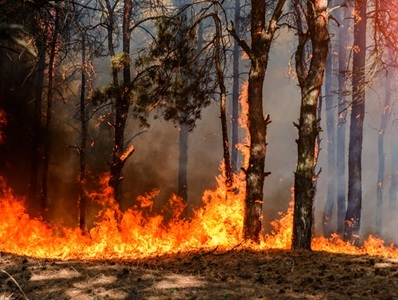
After more than a decade of steady decreases, surface ozone (O3) trends in North America reversed in 2015 despite policy mitigation efforts. The new research, published in Science, links this reversal to O3 emissions from wildfires, and notes a related rise in premature mortality.
“Despite regulated reductions in anthropogenic emissions of O3 precursors, observation stations indicate that policy-relevant surface O3 levels have plateaued,” the authors write.
They describe the relationship between wildfires and surface O3 trends more closely by using deep learning models to evaluate existing yet sparse EPA, satellite and meteorological measurements, generating a dataset of daily surface O3 measurements at a 1-kilometer resolution in North America from 2003 to 2024. Doing so revealed that O3 trends flipped from a decrease of 0.65 parts per billion (ppb) per year before 2015 to an increase of 0.13 ppb per year after 2015. Further analyses determined this post-2015 rate would have stayed in decline (−0.25 ppb per year) if not for wildfire emissions.
The authors also examined correlations between O3 trends and premature deaths, attributing emissions to an additional 318 deaths per year since 2013. Essentially, after 2013, the mortality rate attributable to wildfire-sourced O3 rose by 46%.
The researchers also examined O3 emissions from 2022 to 2024, a period marked by extreme fires and smoke in Canada. Results showed wildfire emissions alone exposed 43 million people to unhealthy levels of air pollution, in excess of the United States’ O3 air quality standard of 70 ppb. The authors suggest that these emissions prevented the United States from tightening its O3 air quality standard by 4 ppb.
“If the O3 standard were lowered to 65 ppb, 60% of the population (202 million people) would fall into nonattainment, and under a 60-ppb standard, the fraction would increase to 87% (294 million people). These findings demonstrate the challenge in adopting a more stringent O3 standard as growing wildfires contribute to high O3 episodes,” the authors conclude.
Data from AAAS