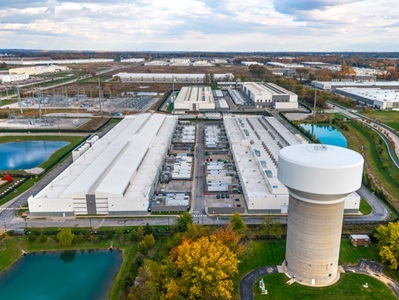
One-quarter of the world’s data centers are located in areas where water demand exceeds supply for at least one month each year, according to a new global analysis.
Researchers reporting in ACS’ Environmental Science & Technology mapped data center locations against available water resources and found that, under a future climate scenario, the proportion of facilities in water-stressed areas could rise to one-third.
Thousands of data centers worldwide provide the information storage and computing power for today’s artificial intelligence technologies. These facilities consume large volumes of water to cool servers and prevent overheating. They use the same supplies as nearby communities and industries, including agriculture and manufacturing.
For this study, researchers mapped 9,347 operational data centers worldwide against local water availability and the current demand from cities and municipalities, agriculture, manufacturing and power generation. Analysis of their maps showed that about 25% of data centers are in areas that experience water stress at least one month each year, and around 6% are in areas that are stressed most of the year. Cities and municipalities are the largest water users near 41% of data centers, and agriculture is the primary consumer near another 28%.
The researchers also calculated water demand and supply in a future scenario. They used several climate models for global temperatures that are an average of 5.4 degrees Fahrenheit warmer than in 1900—representing anywhere from 10 to 40 years from now.
The results estimate that 33% of today’s data centers could be in regions where water demand will exceed supply. Most of the additional facilities affected by water stress are in the U.S., where 39% of the global total are already located.
“These facilities are not landing in empty landscapes. They are landing on top of the water supply of cities and farms,” said Lorenzo Rosa, lead author and researcher at Biosphere Sciences and Engineering.
Data from the American Chemical Society