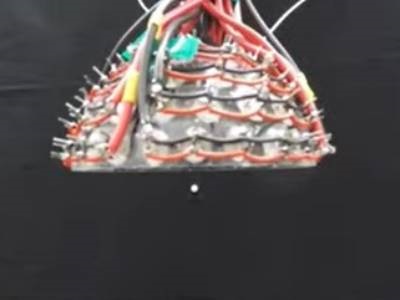
Non-contact manipulation of tiny objects and particles is incredibly useful in a number of scientific fields including microbiology, nanotechnology and materials engineering. Optical tweezers that use lasers to trap sub-microscopic particles have been a breakthrough in these research areas, but are limited in the types of objects they can move. Acoustic trapping has been proposed as an alternative to optical trapping for manipulation of a wider range of object sizes and materials, and is capable of levitating objects up to millimeters in size. A team of researchers at Tokyo Metropolitan University have developed new acoustic tweezers and demonstrated their ability to lift a millimeter-sized ball from a reflective surface using a multi-channel hemispherical ultrasound transducer array.
Ultrasound transducers arranged in a hemispherical array have been used for acoustic trapping and levitation in the past, but lifting objects in mid-air from some distance has been especially difficult when the object is on a rigid surface that reflects sound. The researchers proposed a design that divides 180 transducers into eight blocks, with an inverse filter method used to find the best phase and amplitude to drive each block and form a trap at a target position. The method only requires the eight channels to be individually controlled rather than each individual transducer. By adjusting how they drive the blocks over time, the researchers can change the position of the target field and move the trapped particle.
The team’s findings were supported by simulations of the 3D acoustic fields created by the arrays, and demonstrated by using the new acoustic tweezers to lift and move a polystyrene sphere with a diameter of 3 mm from a rigid, reflective stage. The arrays were able to lift the ball when placed 25 mm above the stage. The research was published in the Japanese Journal of Applied Physics.
The researchers faced some challenges keeping the ball stable while lifting and moving and hope to further develop the technology for more consistent and smooth manipulation of particles for practical applications.
Video Credit: Tokyo Metropolitan University