Microgravity conditions have shown to have valuable effects on crystal growth and the morphogenesis of materials that are not seen under normal gravity conditions on Earth. Crystallization studies in microgravity have been conducted at space laboratories, but these experiments have remained inaccessible to most other research laboratories. A team of researchers from the University of Barcelona, the Catalan Institute of Nanoscience and Nanotechnology (ICN2) and the Institute of Materials Science of Barcelona (ICMAB-CSIC) sought to bring the benefits of microgravity down to Earth, and created a simulated microgravity system that could aid more labs in the study and development of unique 2D crystalline materials.
The research team developed a custom-made microfluidic device to create the simulated space environment. The device consists of two interlinked substrates with a fine silicon film of variable thicknesses from 200 to 500 µm to create a microfluidic environment 6 cm long and 1.5 cm wide. On one of the device surfaces are two machine inlet ports that enable the microfluidic environment to be completely filled and prevent air bubbles. This environment is designed to allow for material synthesis without buoyancy-driven convection.
The team was able to use the device to grow a 2D metal-organic framework (MOF) prototype without defects and with conductivity properties that act at a long distance under ambient conditions. The crystallinity, structure and orientation of the 2D material were studied using grazing-incidence wide-angle X-ray scattering (GIWAXS). The results were published in Advanced Materials.
“The spatio-temporal control in the growth of this material obtained with the simulated microgravity conditions is unprecedented in the scientific literature. The microfluidic device has allowed us to develop centimeter-long thin layers and study the previously undescribed electronic properties of the material,” said first author Noemí Contreras-Pereda. “This new simulated microgravity system will be like a ‘playground’ for chemists, physicists, and materials scientists who want to process 2D functional devices and materials.”
The researchers wrote that homogenous, large thin films could be synthesized in a wide variety of substrates using the simulated microgravity system, with a high control on their crystalline orientation. The system could open up new avenues to study properties such as anisotropy of conductivity in 2D conductive crystalline molecular frameworks.
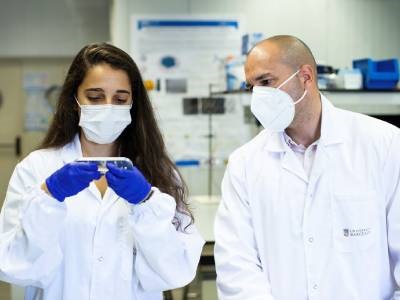
Photo: Noemí Contreras-Pereda (left) of ICN2 and Josep Puigmartí of the University of Barcelona with the simulated microgravity device. Credit: University of Barcelona