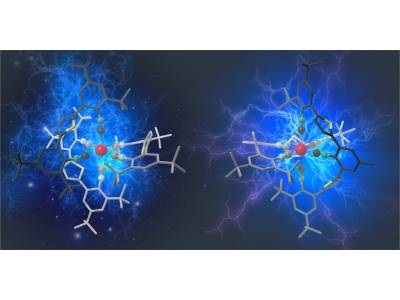
The unique photochemistry of certain rare metals like iridium and ruthenium have been leveraged by scientists to develop materials for applications including lighting for electronic display screens and solar cells for converting absorbed light into energy. One of the main drawbacks of working with these elements is their scarcity and cost; iridium, which is used in organic light-emitting diodes (OLEDs), is rarer than gold and platinum, and ruthenium, used in solar cells, is also one of the rarest stable elements. Researchers from the University of Basel recently developed a new class of metal complexes with similar properties to these rare metals, but that are based on a much more abundant and less expensive element: manganese.
The new complexes created by the researchers are luminescent and can catalyze artificial photosynthesis at high speed, making them a promising inexpensive alternative for use in OLEDs, solar cells and other technologies that rely on the photochemistry of noble metals. The manganese compounds exhibit metal-to-ligand charge transfer (MLCT) luminescence and can glow in solution at room temperature, something lead researcher Oliver Wenger said has not been previously achieved using manganese complexes. The complex structures also enable immediate charge transfer from the manganese toward its direct bonding partners on excitation, a design that is already used in some solar cells but mostly in those containing rare metals.
Attempts to use inexpensive metals for these photochemical functions have been challenging due the fact that the absorption of light causes greater distortion in complexes made from common metals than it does in noble metal compounds. This distortion causes the complexes to vibrate and lose a large part of the absorbed light energy. The University of Basel researchers managed to suppress these distortions and vibrations in their manganese complex design by incorporating tailor-made molecular components that force the manganese into a rigid environment. This design also increases the stability of the compounds and improves their resistance to decomposition processes. The team’s research was published in Nature Chemistry.
“[The team] really made a breakthrough in this respect—one that opens up new opportunities beyond the field of noble metals,” said Wenger.
Currently, the new manganese complexes still do not perform as well as iridium compounds in terms of their luminous efficiency, something the team hopes to improve on through future research. The researchers will also work on anchoring the compounds to suitable semiconductor materials for use in solar cells. Eventually, manganese complexes could even be developed into an alternative for ruthenium and iridium compounds in photodynamic therapy to treat cancer.
Photo: Illustration of manganese complexes with luminescent and photocatalytic properties similar to rare metals like iridium and ruthenium. Credit: Jakob Bilger