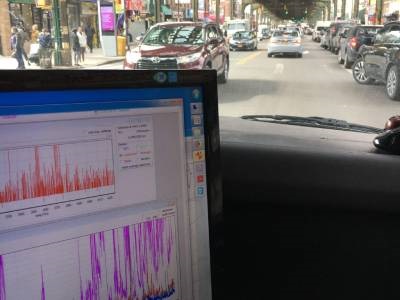
Fossil fuel emissions have long been a central concern in regard to both climate change and air pollution, spurring regulations over the last few decades that have significantly reduced emissions in some areas. However, despite some major air quality improvements, many densely-populated urban areas still see excessive ozone pollution. National Oceanic & Atmospheric Administration (NOAA) researchers in a mobile laboratory van traveled to large cities in the United States and Europe to investigate other sources of air pollution, and found that volatile organic compounds (VOCs) from personal products such as deodorant, bug spray and lotion can have a near-equal or even greater impact on ozone pollution than traffic emissions in these urban settings.
The NOAA van equipped with gas chromatography-mass spectrometry (GC-MS) and proton transfer reaction time-of-flight mass spectrometry (PTR-TOF-MS) equipment traveled to cities including New York City, Chicago and Boulder, Colo. in the United States, and Bern, Switzerland and Vienna, Austria in Europe. The researchers assigned different signatures to emissions from different sources based on ratios of tracer molecules; higher levels of benzene likely meant the pollution was coming from fossil fuels, while higher decamethylcyclopentasiloxane (D5-siloxane) levels indicated likely pollution from personal products like antiperspirant and shampoo.
Tests performed in the mobile lab during 2018 showed that VOC levels from personal care products were comparable to those from transportation in these densely-populated cities, and that levels of personal product emissions correlated with population density. In Manhattan, which is very densely populated, 78% of VOCs were found to be from personal products, ranging from paints and cleaners to hygeine products, while only 22% of VOCs came from traffic. In Boulder, which has a much less dense population than New York City, about 42% of human-caused VOCs were from personal consumer products.
Lead study author Matthew Coggon estimated that nationwide, an average of 50-80% of urban VOC pollutants come from personal products. The researchers also found that ozone pollution from these products was most significant during the summer. The study was published in the Proceedings of the National Academy of Sciences and conducted in collaboration with the Cooperative Institute for Research in Environmental Sciences (CIRES) at the University of Colorado Boulder.
“Seeing all those cars when biking to work in Boulder, Colorado convinced me they had to be the dominant VOC source,” said CIRES researcher Georgios Gkatzelis. “But after driving our NOAA van through New York City and watching our instrument displays, Matt and I were often shouting at each other in amazement at what we were seeing.”
The researchers said their work shows that personal care products should become a focus in efforts to reduce air pollution, in addition to fossil fuels. The mobile laboratory is now on the road again to conduct similar studies in the Southwest United States, where the team will test ozone pollution sources in Las Vegas and Los Angeles.
Photo: National Oceanic & Atmospheric Administration (NOAA) researchers traveled with analytical instruments in a mobile laboratory van to several major cities in order to test air samples and measure levels of volatile organic compounds (VOCs) from different sources. Credit: NOAA Chemical Sciences Laboratory