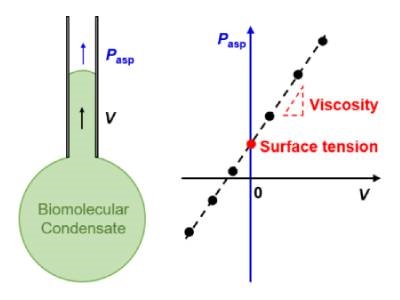
Biomolecular condensates — membraneless compartments of proteins and RNA that form through liquid-liquid phase separation (LLPS) within cells — are believed to play an important role in many cellular processes, and have been linked to the pathology of neurodegenerative diseases like amyotrophic lateral sclerosis (ALS), Alzheimer’s disease and Parkinson’s disease. Measuring the material properties of these condensates can help us better understand the mechanisms of these diseases, but techniques for determining the viscosity and surface tension of these protein droplets have so far been limited. Rutgers University researchers have recently adapted a simple method to quantify both the viscosity and surface tension of these tiny droplets using two ubiquitous laboratory tools: a micropipette and a microscope.
Micropipette aspiration (MPA) has long been used as a way to measure the biomechanical properties of liposomes, polymersomes and cells, but is much more difficult to use to quantify the properties of liquid samples. This is because MPA relies on imaging the movement of a sample through the pipette in response to pressure, and low-viscosity liquids move too quickly to be properly imaged. However, biomolecular condensates have an extremely high viscosity and extremely low surface tension, making them a more viable candidate for analysis using this technique.
The researchers tested the ability of MPA to quantify the properties of a protein condensate, using both transmitted light and fluorescence microscopy to image the aspiration. The surface tension and viscosity values measured through MPA were found to agree with both previously published and subsequent evaluations through two other methods: condensate fusion for surface tension and fluorescence recovery after photobleaching (FRAP) for viscosity. MPA has the advantages of being able to measure both values using the same test and being a relatively easy and user-friendly technique. This research was published in Biophysical Reports.
“The fact that we can apply the micropipette technique to accurately measure biomolecular condensates highlights a major difference between protein droplets and common liquids: the surface tension of protein droplets are thousands of times lower, while their viscosity are thousands of times higher than those of oil or water,” said senior author Zheng Shi, of Rutgers-New Brunswick. “We can now finally study in a quantitative manner how material properties of protein droplets change during neurodegeneration. We anticipate this technique will be widely applicable and resolve several limitations regarding current approaches. It will open doors for unraveling the mechanisms as well as facilitating therapeutic advances in the treatment of these diseases.”
Previous studies have linked increasing viscosity of biomolecular condensates to the formation of fibrils that underlie some neurodegenerative diseases. Having an easier method to quantify the rheology of these protein droplets can help accelerate the study of these diseases and their potential future therapies.
Photo: Rutgers researchers applied micropipette aspiration to quantify the surface tension and viscosity of biomolecular condensates. Changes in the material properties of these condensates have been linked to neurodegenerative diseases. Credit: Rutgers University