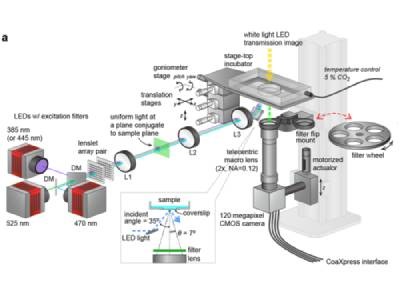
Microscopy has helped scientists overcome the limits of human vision and allowed us to observe tiny organisms, individual cells and subtle movements in high resolution. One limitation that conventional microscopes still face is a small field of view, allowing only small groups of cells to be observed at once and making it more difficult to see the “big picture” of a full organism or large population while still resolving individual details. Researchers from Osaka University have developed an imaging system to allow for a larger number of cells to be viewed simultaneously in micrometer resolution, using a 120-megapixel camera and telecentric macro lens to study a population of more than one million cells.
The team’s imaging technology, called a “trans-scale scope” and given the name AMATERAS (a multi-scale/modal analytical tool for every rare activity in singularity), increases the field of view of a typical microscope from a few square millimeters up to about a 1½ cm by 1 cm area. The set-up leverages machine vision with the ultra-high pixel camera and low-power macro lens to view a larger area, maintain micrometer resolution and expand the population that can be viewed simultaneously from about 1,000 cells with conventional microscopes to more than 1 million.
Using their trans-scale scope system, the team dynamically imaged calcium ions in cultured amoeba cells and were able to detect “one in a million” anomalies — rare differences only seen in 0.01% of cells — and their effects on other cells. The research was published in Scientific Reports.
“As a technological singularity for a powerful cell measurement, our trans-scale scope system AMATERAS is expected to contribute to a wide range of applications, from basic research for understanding the operating mechanism of multicellular systems, to medical applications such as the quality control of artificial cell sheets,” said senior author Takeharu Nagai.
The team’s work could accelerate research in fields that deal with large cell populations, such as neuroscience, oncology and immunology. The ability to view such a large population at once can aid in the detection of other rare anomalies and differences among these populations.
Photo: Schematic showing the configuration of the trans-scale scope system AMATERAS1.0. Credit: T. Ichimura et al., Scientific Reports