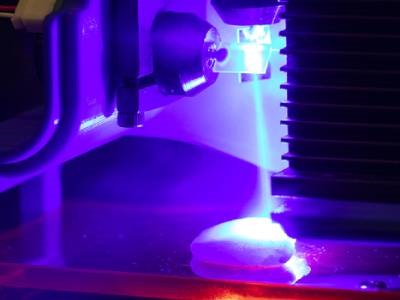
A fully automated robot chef may sound like something from a sci-fi movie, but a recent engineering endeavor shows the concept may not be that far out of reach. 3D printing technology has allowed for precise, automated assembly of various parts and objects using unique materials and composites as “ink” — including food. Not all food will be ready to eat immediately after printing, however, which is why engineers at the Columbia University School of Engineering and Applied Science sought to automate the next step of the culinary process by cooking 3D-printed chicken using lasers.
The researchers printed raw chicken samples that were 3 mm thick and about a square inch in area and investigated the ability of blue light (445 nm) and infrared light (980 nm and 10.6 μm) to cook the printed meat. The samples were printed and cooked on the same machine, with laser exposure beginning after the layer was fully printed. After cooking, the team tested parameters such as cooking depth, color development, moisture retention and flavor differences between laser-cooked and stove-cooked chicken. Additional sample shapes and laser configurations were also tested.
The engineers found that IR light browned the meat more efficiently than blue light, and that NIR light could also brown and cook chicken through plastic packaging. Additionally, compared with stove cooking, the laser cooking method caused the chicken to retain twice as much moisture with 50% less shrinkage. Two blind taste-testers who tried the laser-cooked and stove-cooked meat also said they preferred the laser-cooked chicken, according to first author Jonathan Blutinger. The study was published in npj Science of Food.
“We noted that, while printers can produce ingredients to a millimeter-precisions, there is no heating method with this same degree of resolution. Cooking is essential for nutrition, flavor, and texture development in many foods, and we wondered if we could develop a method with lasers to precisely control these attributes,” Blutinger said. “... Food is something that we all interact with and personalize on a daily basis—it seems only natural to infuse software into our cooking to make meal creation more customizable.”
The engineers said technology like theirs could be applied in a future “Food CAD” market, similar to a “Photoshop of food,” in which users could design their own foods and share digital recipes online.
Photo: Chicken being cooked by a blue laser. Light is being directed by two software-controlled mirror galvanometers. Credit: Jonathan Blutinger/Columbia Engineering