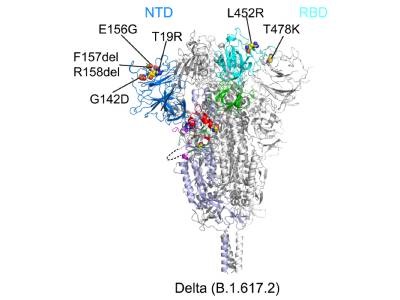
The Delta variant of SARS-CoV-2 has become a major focus in efforts to control the COVID-19 pandemic due to its higher transmissibility compared with other strains. While this enhanced threat has already been recognized by many public health organizations, what makes the Delta variant more contagious than other variants continues to be studied down to the cellular and molecular level. Now, a research team at Boston Children’s Hospital has published a study revealing more details about changes in the virus’ transmissibility and spike protein structure through cell-based assays and high-resolution cryo-electron microscopy (cryo-EM).
The researchers performed cell-cell fusion assays using simulated G614, Alpha, Beta, Gamma, Delta and Kappa virus variants to assess their fusion efficiency, and discovered that cells expressing the Delta spike protein fused much more quickly and efficiently with other cells than those expressing other variants. Additionally, the Delta spike protein allowed for more efficient fusion in cells with relatively low ACE2 receptor expression. These results suggest that faster and more efficient cell fusion is an underlying mechanism of Delta’s increased transmissibility.
The team also imaged the spike proteins of the Delta, Kappa and Gamma variants through cryo-EM and compared the protein structures to those of the previously characterized G614, Alpha and Beta variants. All of the strains showed changes to the receptor-binding domain (RBD) and N-terminal domain (NTD) of the spike protein, but the images revealed that there was a larger change in the NTD of the Delta variant than in the other strains. The RBD of the Delta variant also showed no major structural changes that would affect its ACE2 receptor binding abilities, and the variant is still sensitive to most anti-RBD antibodies. In general, the RBD changes in all of the variants were relatively limited, possibly reflecting the virus’ need to retain this domain’s crucial receptor binding properties, while changes to the NTD may be less consequential for the virus’ survival. This study was published in Science.
“We wouldn’t want to target the NTD, because the virus can quickly mutate and change its structure; it’s a moving target,” said study author Bing Chen. “It might be most effective to target the RBD — to focus the immune system on that critical domain rather than the whole spike protein.”
These insights into the Delta variant’s fusion efficiency may explain its abilities to infect individuals after a shorter exposure, infect more cells and produce such a high viral load, Chen said. And comparisons of the similarities and differences between the spike protein structures of the different variants may help scientists formulate strategies for vaccines and antibody treatments that will be effective for more strains.
Photo: This ribbon diagram shows the structure of the Delta variant’s spike protein before the virus fuses with its target cell. The N-terminal domain (NTD) is shown in blue and the receptor-binding domain (RBD) in cyan. Credit: Bing Chen, PhD, Boston Children's Hospital