Researchers at the Department of Energy’s Oak Ridge National Laboratory designed a novel polymer to bind and strengthen silica sand for binder jet additive manufacturing, a 3D-printing method used by industries for prototyping and part production.
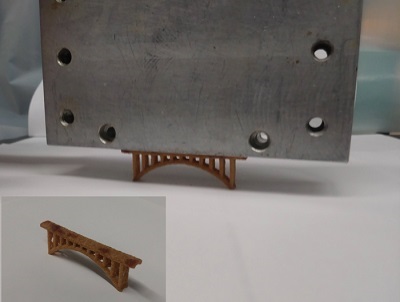
The study, published in Nature Communications, demonstrates a 3D-printed sand bridge that at 6.5 centimeters can hold 300 times its own weight, a feat analogous to 12 Empire State Buildings sitting on the Brooklyn Bridge.
The team used polymer expertise to tailor a polyethyleneimine, or PEI, binder that doubled the strength of sand parts compared with conventional binders.
Parts printed via binder jetting are initially porous when removed from the print bed. They can be strengthened by infiltrating the design with an additional super-glue material called cyanoacrylate that fills in the gaps. This second step provided an eight-fold strength increase on top of the first step, making a polymer sand composite stronger than any other and any known building materials, including masonry.
“Few polymers are suited to serve as a binder for this application. We were looking for specific properties, such as solubility, that would give us the best result. Our key finding was in the unique molecular structure of our PEI binder that makes it reactive with cyanoacrylate to achieve exceptional strength,” said ORNL’s Tomonori Saito, a lead researcher on the project.
Parts formed with conventional binders are made denser with infiltrate materials, such as super glue, but none have reached close to the performance of the PEI binder. The PEI binder’s impressive strength stems from the way the polymer reacts to bond with cyanoacrylate during curing.
One potential application for the super-strength sand is to advance tooling for composites manufacturing.
“To ensure accuracy in tooling parts, you need a material that does not change shape during the process, which is why silica sand has been promising. The challenge has been to overcome structural weakness in sand parts,” said Dustin Gilmer, a University of Tennessee Bredesen Center student and the study’s lead author.
Photo: A novel polymer developed at Oak Ridge National Laboratory strengthens sand for additive manufacturing applications. A 6.5 centimeter 3D-printed sand bridge, shown here, held 300 times its own weight. Credit: Dustin Gilmer/University of Tennessee, Knoxville