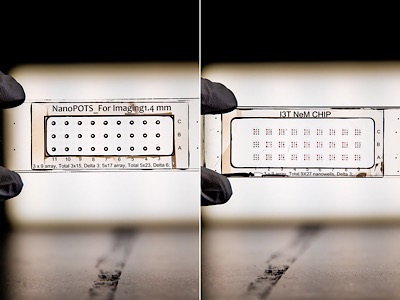
Miniaturization of samples and assays, which can preserve resources and increase throughput, has become increasingly common thanks to more sensitive detection instruments and advancements in nanoscale design and manufacturing. In 2018, researchers from Pacific Northwest National Laboratory (PNNL) introduced a miniaturized single-sell proteomics device called nanoPOTS, which contained 27 nanowells for efficient screening of single-cell samples. Now, PNNL has announced an upgrade to its previous design that increases the number of wells by a factor of nine.
The new version of nanoPOTS, which stands for Nanodroplet Processing in One pot for Trace Samples, contains a total of 243 nanowells nested in 27 clusters on a chip. Each nest containing nine nanowells is used for one multiplexed tandem mass tag (TMT) experiment. Single-cell samples in one TMT set can be pooled simply by depositing a microliter droplet on one nested area, and a hydrophilic ring surrounds the nested wells in order to confine the droplet position.
The second nanoPOTS chip design, referred to as N2, was used to analyze about 100 individual mouse sells from the lung, immune system and axillary lymph node vessel, and the researchers were able to quantify about 1,500 proteins in each cell in order to classify the cells based on protein abundance. The new design resulted in even higher throughput and efficiency than the original nanoPOTS, which had already reduced sample loss by more than 99% compared to other technologies at the time it was released. Details on the latest design were published in Nature Communications.
“We are also working to make this technology easy for other laboratories to use,” said Ying Zhu, corresponding author on the paper. “The N2 chip can be manufactured in a standard clean room, and we used a commercial single-cell isolation system for liquid handling rather than a custom-built system as before.”
PNNL recently licensed the nanoPOTS technologies to the biotechnology companies SCIENON and Cellenion. The partnership aims to combine the companies’ precision liquid handling systems with nanoPOTS technology in order to create a complete, effective system for sample preparation for single-cell mass-spectrometry-based proteomics, said PNNL commercialization manager Jennifer Lee.
Photo: The original nanoPOTS chip (left) had 27 individual nanowells organized on the surface. The new nested nanoPOTS chip (right) has an array of 27 nested areas, each containing nine nanowells, on the surface. Credit: Andrea Starr | Pacific Northwest National Laboratory