Recording neural activity in real time requires extremely fast and extremely sensitive imaging systems, and is often limited by a small field of view or inability to look into deeper parts of the brain of a living animal. Two-photon microscopy is one technology that has helped scientists obtain high-resolution images in deeper parts of the brain using near-infrared (NIR) light to minimize scattering and suppress background signals. Now, researchers at the University of California (UC) Santa Barbara have designed an advanced two-photon fluorescence microscopy system with subcellular resolution and a wide field of view and made the design freely available for other researchers to replicate.
The system, referred to as the “duel independent enhanced scan engines for large field-of-view two-photon imaging” (Diesel2p), has a field of view up to 25 square millimeters for imaging multiple areas of the mouse brain simultaneously with high enough resolution to view individual neurons, explained Spencer LaVere Smith, who led the research. The system also utilizes ultrafast, ultra-intense pulsed lasers with a single beam split into two wholly independent scan engine arms, each configured to different imaging parameters. This allows different regions of the brain to be scanned at the same time using optimal parameters for each region.
The two-photon excitation method utilizes a single point of light in sharp focus to eliminate out-of-focus light from reaching the lens, allowing deeper penetration into the brain tissue than optical microscopy. The use of NIR wavelengths also reduces light scattering, and minimizes damage to the sample caused by higher-energy radiation such as ultraviolet (UV) light. The Diesel2p system was tested using mice implanted with glass cranial windows to observe their neural activity as they performed tasks such as watching videos and navigating virtual reality environments.
The system design was previously released in a preprint with the engineering details needed to replicate it, and the technology was also shared with researchers in the Jerry Chen lab at Boston University, where it was adapted to suit new experiments. A peer-reviewed research article describing the design was recently published open-access in Nature Communications.
“This is exciting. They didn’t have to start from scratch like we did. They could build off of our work,” said Smith. “Jerry’s paper was published back-to-back with ours, and two companies, INSS and CoSys, have sold systems based on our designs. Since there is no patent, and won’t be, this technology is free for all to use and modify however they see fit.”
Using techniques such as two-photon microscopy to observe the brain activity of mammals such as mice can ultimately help to unravel details about the neural circuitry of humans. This work was a product of the NSF-funded Next Generation Multiphoton Neuroimaging Consortium (Nemonic), which is housed at UC Santa Barbara and is working to “push the frontiers of multi-photon microscopy for neuroscience research,” said Smith, who is the principal investigator on the Nemonic project.
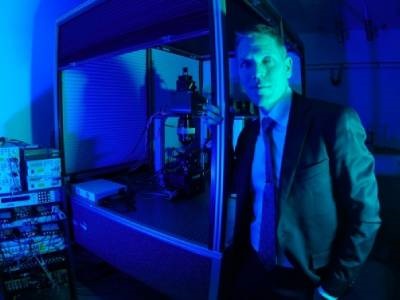
Photo: Spencer LaVere Smith in the lab with the Diesel2p microscope. Credit: UC Santa Barbara College of Engineering