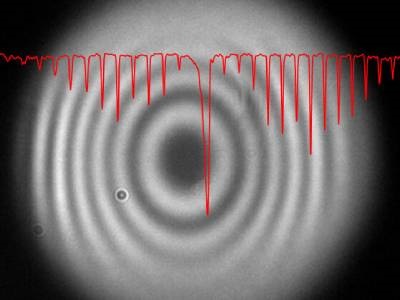
The quantum mechanical entanglement of photons presents unique possibilities for optical technology, including imaging and analytical technologies such as microscopy and spectroscopy. Entangled photons can remain inextricably connected to one another across great distances and wavelength ranges, potentially providing a gateway to probe previously inaccessible areas of the electromagnetic spectrum. Researchers from six institutes at Fraunhofer-Gesellschaft recently concluded a four-year project to study entangled photons as a tool for advancing optical solutions through quantum methods and have published their results to help pave a way for the development of new optical technologies.
The underlying principle of the lighthouse project, titled “QUILT - Quantum Methods for Advanced Imaging Solutions,” is that when one photon in an entangled pair can be captured via conventional methods and the other is made to interact with an “invisible” subject, information from the second photon will be transferred to the other and recorded. One example of this is “quantum ghost imaging,” which QUILT project researchers conducted using single photon avalanche diode (SPAD) detectors and asynchronous detection, enabling three-dimensional quantum ghost imaging for the first time. This work was outlined in a paper published in Applied Optics.
Another possibility explored through the project was the detection of terahertz radiation using quantum methods. While terahertz radiation is difficult to detect directly, the use of entangled photons can allow for terahertz-spectral information about chemicals and materials to be “translated” through easily detectable visible spectrum photons. The QUILT researchers developed a nonlinear interferometer and generated entangled pairs of visible and terahertz photos to detect the terahertz-range absorption features of 𝛼-lactose monohydrate and para-aminobenzoic acid crystals, demonstrating the efficacy of their technique, dubbed quantum-inspired terahertz spectroscopy (QIS). This study was published in Optica. The researchers have also used these quantum techniques to improve the specific detectivity of Fourier transform infrared spectroscopy (FTIR) in the mid-IR range, as previously published in Optics Express.
These studies and more published through the QUILT project offer a cornerstone for further industrial applications of quantum optical methods, including in the areas of environmental testing, materials testing, life sciences and biomedical research. The project has also resulted in the submission and granting of seven patents, and the researchers plan to continue to collaborate with industry partners to explore the potential applications of their techniques. The institutes involved in this project included the Fraunhofer Institutes for Applied Optics and Precision Engineering; Laser Technology; Microelectronic Circuits and Systems; Optronics, System Technologies and Image Exploitation; Physical Measurement Techniques; and Industrial Mathematics.
Photo: Using entangled photons and interference effects, infrared spectra of molecules (here: methane) can be recorded by cameras that can only detect visible light. Credit: Fraunhofer IPM