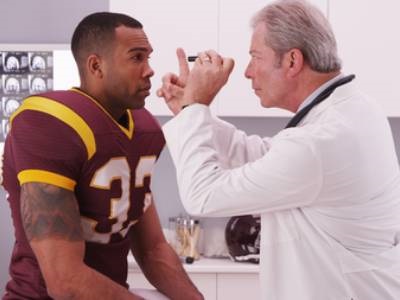
Mild traumatic brain injuries (mTBIs), also known as concussions, can cause troubling symptoms and become more serious or even deadly if multiple concussions occur within a short timeframe. For these reasons, timely and accurate mTBI diagnosis is important for both athletes and other concussion patients, yet concussions remain difficult to definitively diagnose and monitor, and often don’t show up on routine brain scans such as MRIs or CTs. A recent study at Boston Children’s Hospital showed that clinical chemistry may hold the answer to more reliable diagnosis of concussion based on two potential biomarkers that can be found in urine.
The researchers worked with a local college and collected urine samples from athletes during preseason evaluations. When athletes were diagnosed with concussions by a sports medicine physician during the season, their urine was collected again within seven days of the injury, followed by additional samples one, three, six and 12 months after the injury. The team ultimately gathered enough samples to compare the urine profiles of 95 athletes, including 48 who had sustained concussions and 47 controls. The samples were analyzed using Tandem Mass Tag (TMT) mass spectroscopy (MS) and enzyme-linked immunosorbent assays (ELISAs).
A total of 71 proteins were found to differ significantly between athletes who sustained a concussion and the control subjects. Of these proteins, two stood out: insulin-like growth factor 1 (IGF-1) and the IGF-binding protein 5 (IGFBP5). The researchers found that levels of these two proteins decreased significantly in post-concussion urine samples compared to samples collected before the concussions occurred. The team theorized that IGF-1 and IGFBP5 may be involved in brain injury repair, and thus are retained in the body after a concussion rather than excreted through urine. Used in conjunction with gait evaluations, these two proteins were found to distinguish between athletes with and without concussion with high reliability. This research was published in the journal Neurology.
“In many illnesses, markers of physical and biological damage find their way into the bloodstream, and can often be found in the urine,” said Marsha Moses, who led the study. “Urine testing can be done early and often and is inexpensive compared to other types of tests.”
The team now hopes to validate its proof-of-principle study through clinical trials that include different populations such as adolescent athletes and people with non-sports-related concussions.