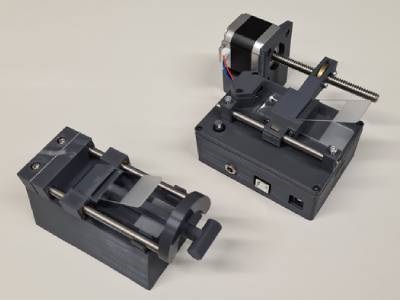
Blood smears, in which a drop of blood is spread into a thin layer on a microscope slide, are used to diagnose several blood-borne diseases such as malaria. The ability to make accurate diagnoses using this technique requires high-quality, consistent smears typically relying on the skill of the technician creating the smears by hand. In order to speed up this diagnostic process, as well as ensure greater consistency and accuracy than can be achieved by hand, researchers at Cambridge University, Bath University and the Ifakara Health Institute have now developed 3D-printed devices that can quickly, automatically and reliably create high-quality blood smears.
The two device designs, known as the autohaem smear and smear+, can be printed and assembled using the widely-available and relatively inexpensive material PLA along with other commonly-available non-printed parts and tools. The designs are published open-source meaning anyone with access to a 3D printer and the necessary supplies can produce these devices locally. The autohaem smear is operated manually and ensures consistent quality smears by fixing the spreader blade at the proper angle and position relative to the sample slide as the user simply moves the handle. The smear+ includes electrical components in order to automate the process completely, allowing for even greater consistency and speed.
One of the central aims of these compact, portable devices is to both improve accuracy and reduce bottlenecks in diagnosing diseases such as malaria, especially in areas that may lack resources. The open-source designs and relatively inexpensive materials used to produce these devices can make them more accessible in lower-income countries, where 3D printers are becoming increasingly common as a tool for prototyping and manufacturing, the researchers wrote. Team members from the Ifakara Health Institute in Tanzania now plan to manufacture and test these devices in real-world conditions, and use their experience to further improve upon the designs. This work was recently published in Review of Scientific Instruments.
“In some countries, up to 81.5% of blood smears are prepared incorrectly,” said author Samuel McDermott, of Cambridge University. “If a blood smear is prepared incorrectly, when examined under a microscope, the technician will struggle to make a correct diagnosis. Because these smears are often made in a rural clinic and sent to a regional facility for examination, any issues in the smear could cause days of delay.”
Streamlining and/or automating this process can reduce the possibility of errors and minimize delays, as the researchers have demonstrated that the autohaem smear and smear+ devices perform as well as an expert technician making a smear, even when operated by an inexperienced user. These devices could prove valuable in areas where malaria is widespread and laboratories must perform these smears on a frequent basis.
Photo: The autohaem smear and smear+, two devices usable by anyone and capable of producing expert-quality blood smears. Credit: Samuel McDermott