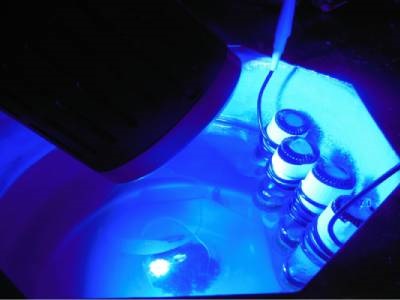
Cross-coupling reactions performed for processes such as acylation and arylation are some of the most essential and widely used reactions for synthesizing chemicals in pharmaceutical and other applications. In many cases these reactions rely on precious metals such as palladium for catalysis, but copper catalysts offer the potential to decrease costs and improve sustainability due to the relative abundance of copper in the environment. Researchers from Hokkaido University recently demonstrated how blue LEDs and copper-based catalysts can be used for asymmetric acylation of allylic phosphates with acylsilanes, presenting the advantages of this method for simplifying and improving similar reactions.
One of the major advantages of this method is that the copper contained in the molecular catalyst absorbs blue light from the LEDs, meaning a separate light-absorbing compound is not needed for the photoinduced reaction. This not only makes the method more cost-effective, but also makes the process easier to control due to fewer components being involved. Theoretical calculations performed by the researchers showed that exposure to blue light made the catalyst much more reactive by inducing copper-to-acyl metal-to-ligand charge transfer, resulting in a charge-separated triplet state. The asymmetric formation of the acyl group means a specific enantiomer can be selectively produced, which is especially valuable for the development of new medicines.
The researchers tested their method with several different starting materials, including a material derived from the gout medicine probenecid. Their results demonstrated the high selectivity of the method as well as its compatibility with several compounds used in the production of pharmaceuticals. Because the technique uses easily accessible and abundant supplies and materials, it provides a potentially cost-saving and more sustainable alternative to other methods that use precious metals as catalyzing agents. This research was published in the Journal of the American Chemical Society.
“This synthetic method is a breakthrough because it combines two easily obtainable items, blue LED light and copper, to achieve a coupling reaction that did not exist before,” said study co-author Yusuke Masuda. “Technology that produces useful compounds from resources which are abundantly available on Earth is critical for the sustainable development of humanity. I expect this advance will become a milestone in the development of sustainable molecular synthetic methods.”
In addition to the pharmaceutical industry, this method can also be applied in other fields that rely on cross-coupling reactions for chemical synthesis, such as the field of photoelectronic development.
Photo: Reaction vials being exposed to blue light from an LED. Credit: Yusuke Masuda