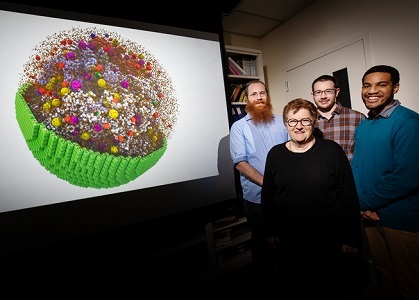
Scientists report that they have built a living “minimal cell” with a genome stripped down to its barest essentials – and a computer model of the cell that mirrors its behavior. By refining and testing their model, the scientists say they are developing a system for predicting how changes to the genomes, living conditions or physical characteristics of live cells will alter how they function.
They report their findings in the journal Cell.
The simulation maps out the precise location and chemical characteristics of thousands of cellular components in 3D space at an atomic scale. To build the minimal cell, scientists at the J. Craig Venter Institute in La Jolla, California, turned to the simplest living cells – the mycoplasmas, a genus of bacteria that parasitize other organisms.
Simulating something as enormous and complex as a living cell relies on data from decades of research, said Zaida (Zan) Luthey-Schulten, a chemistry professor at the University of Illinois Urbana-Champaign who led the work with graduate student Zane Thornburg. To build the computer model, she and her colleagues at Illinois had to account for the physical and chemical characteristics of the cell’s DNA; lipids; amino acids; and gene-transcription, translation and protein-building machinery. They also had to model how each component diffused through the cell, keeping track of the energy required for each step in the cell’s life cycle. NVIDIA graphic processing units were used to perform the simulations.
“We built a computer model based on what we knew about the minimal cell, and then we ran simulations,” Thornburg said. “And we checked to see if our simulated cell was behaving like the real thing.”
The simulations gave the researchers insight into how the actual cell “balances the demands of its metabolism, genetic processes and growth,” Luthey-Schulten said. For example, the model revealed that the cell used the bulk of its energy to import essential ions and molecules across its cell membrane. This makes sense, Luthey-Schulten said, because mycoplasmas get most of what they need to survive from other organisms.
The simulations also allowed Thornburg to calculate the natural lifespan of messenger RNAs, the genetic blueprints for building proteins. They also revealed a relationship between the rate at which lipids and membrane proteins were synthesized and changes in membrane surface area and cell volume.
Photo: With their colleagues, researchers, from left, graduate student Zane Thornburg, chemistry professor Zaida (Zan) Luthey-Schulten and graduate students Benjamin Gilbert and Troy Brier successfully simulated a living “minimal cell.” The advance will aid in creating computer models that accurately predict how living cells will behave when changes are made to their genomes or other characteristics. Credit: L. Brian Stauffer