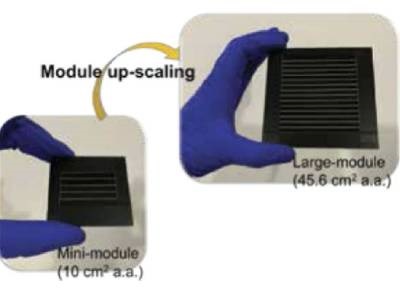
Spin-coating is a preferred method for producing perovskite photovoltaic materials on a small scale, and results in high-quality materials when performed on substrates a square centimeter or two in size. However, this high-performance method of perovskite coating is less effective on larger substrates and thus is impractical for industrial-scale production of solar cells, despite its advantages. Now, an international team including researchers from North Carolina State University and Brookhaven National Laboratory have developed a new strategy that adapts the spin-coating method for larger scale production applications using a co-solvent dilution strategy to create larger, higher-quality materials in a cost-effective and sustainable manner.
Spin-coating refers to the process of placing a liquid material on the surface of a substrate and then spinning the substrate to spread the liquid material over the surface. The problem with this method for perovskite application is that the solvents that keep the perovskite in a liquid state evaporate too slowly, resulting in problems such as irregular thickness when dealing with a substrate surface larger than a couple square centimeters. Other problems with this method include some areas of the coating taking longer than others to dry, and waste resulting from the liquid perovskite flying off the edges of the substrate.
The researchers aimed to solve these problem using a co-solvent, tetrahydrofuran (THF), that enables the perovskite to spread evenly and dry quickly and uniformly, improving the performance of the thin film and reducing the amount of waste lost from ejection off the edges of the substrate. The team tested different concentrations of THF mixed with a conventional perovskite precursor solution to determine the optimal amount of co-solvent to produce the highest quality material, and also compared the THF co-solvent solutions with control precursor solutions and solutions diluted with DMF/DMSO. The films produced using the different perovskite solutions were examined via methods including scanning electron microscopy (SEM), grazing-incidence wide-angle X-ray scattering (GIWAXS), X-ray diffraction (XRD) and UV-Vis spectroscopy to assess qualities such as film thickness, crystal size and surface coverage.
Solutions diluted with 200 v% THF resulted in high uniformity and power conversion efficiency of the resulting film without any detrimental reduction in film thickness. The researchers were able to use spin-coating and co-dilution with THF to produce high-performance perovskite films across substrates tens of centimeters across, demonstrating the method's viability for potentially manufacturing larger solar cells. Additionally, THF is relatively inexpensive and eco-friendly, and the reduction of toxic waste from loss of perovskite during the spin-coating process is another benefit in terms of cost and environmental impact. This research was published in Nature Communications.
“The beauty of this technique is that many industries already use spin coating technologies to produce all sorts of products,” said Aldo Di Carlo, a co-corresponding author of the paper and a professor at the University of Rome Tor Vergata. “Our work demonstrates that these existing technologies could be used to create perovskite solar cells. This could really accelerate the production and deployment of perovskite solar panels and cells.”
The researchers are now looking into automating the spin coating process and working with public and private partners to move closer to large-scale production of these high-performance materials, according to Aram Amassian, a co-corresponding author and professor of materials science and engineering at North Carolina State University.
Photo: Images showing the scaling up from miniature to large modules produced using the co-dilution perovskite spin-coating method. Credit: Aram Amassian