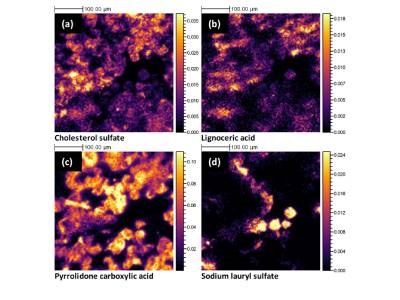
The stratum corneum is the uppermost layer of the skin, serving as a protective barrier between the outside world and the insides of our bodies. The stratum corneum is also the entryway for many topical medicines and skincare products, and understanding the molecular makeup of this skin layer is essential to optimize delivery of these types of treatments. A recently developed mass spectrometry technique has now revealed the most detailed-ever molecular map of the stratum corneum, providing valuable insights for the development of skin treatments and understanding of skin aging and disorders.
The study was conducted at the 3D OrbiSIMS facility at the University of Nottingham, a first-of-its-kind academic research facility combining Time of Flight Secondary Ion Mass Spectrometry (ToF-SIMS) with Orbitrap functionality. The 3D OrbiSIMS technique offers a high mass resolution of greater than 240,000 and a sub-ppm mass accuracy, and allowed the researchers to examine the depth distribution of a wide range of molecules in ex vivo full-thickness human skin tissue samples. The samples were analyzed in a frozen hydrated state to maintain their native structure while also preventing lipid migration throughout the samples.
A single gas cluster ion beam was used to both sputter through the skin sample and generate secondary ions, which were analyzed using the Orbitrap to generate a depth profile. The analysis revealed a range of chemistries and 3D distributions throughout the stratum corneum, with indications for how these relate to fundamental biological processes such as the cholesterol sulfate cycle. The study, conducted as part of a collaboration with the No7 Beauty Company, also involved analyzing the penetration profile of the stratum corneum. The researchers were able to accurately track the penetration of a No7 product containing palmitoyl tripeptide-1, a synthetic peptide designed to repair photo-damage that occurs with aging, following topical application to the skin surface. Permeation of the peptide through the layers of the stratum corneum was analyzed using both ex vivo skin samples and tape strip samples collected from human volunteers in vivo. The results of this research were published in the Proceedings of the National Academy of Sciences (PNAS).
“This research gives the chemical structure detail of the stratum corneum never seen before. The information we were able to gather on the complex chemistry of this tough barrier layer has the potential to benefit research into fundamental biological processes, such as those associated with aging and disease in addition to improving the efficacy of topical delivery,” said corresponding author David Scurr, Principal Research Fellow in the School of Pharmacy at the University of Nottingham.
Mike Bell, head of science research at No7 Beauty Company, added that the research provides commercially significant insights into how companies can produce more effective peptide-based anti-aging products.
Photo: Images of different chemistries found in the stratum corneum. Credit: University of Nottingham