Thermosetting epoxy resin-based composites are used as low-weight, high-performance materials in many applications in the European aerospace sector. However, these materials are not as heat resistant as other aircraft components, such as metal components, and may not be safe enough to use in situations where extreme temperatures are reached. A European research project known as HITCOMP (High Temperature Characterisation and Modelling of Thermoplastic Composites) focuses on a potential alternative to thermosetting plastic composites in the form of new polyaryletherketone (PAEK) resin-based thermoplastic materials, which the HITCOMP team has studied using new infrared (IR) thermography techniques to enable accurate virtual simulations. This project is led and coordinated by the Universidad Carlos III de Madrid (UC3M).
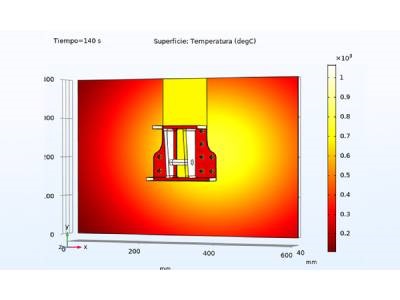
The thermoplastics studied through HITCOMP are less expensive and more eco-friendly than conventional thermosetting composites, and can be recast, reshaped, processed and recycled without the need for any additional curing process, according to the researchers. PAEK resin-based thermoplastic materials also offer a long service life due to their resistance to fatigue and corrosion, and ability to be easily repaired. Due to their low weight, thermoplastics can enable the construction of more efficient aircraft with better fuel economy and lower emissions. The HITCOMP team established a test laboratory and developed novel IR thermography methods to obtain accurate and non-intrusive measurements of the temperatures of materials during fire tests. The ultimate goal of these experiments was to enable virtual tests on thermoplastics and compare their performance in real applications with those of conventional thermosetting composites.
The measurements obtained by the HITCOMP team and the virtualization of thermoplastic materials testing in the aerospace sector are expected to “significantly reduce the number of validation tests, which are mandatory and greatly increase the cost and delay the approval of this type of material in the industry,” said Fernando López, lead researcher and coordinator of the HITCOMP project. The IR models and equipment obtained through the project have now been transferred to the Airbus company to study industrial application of the materials.
“The aerospace sector is undergoing a transition to a more electric aircraft. This involves more heat and eventually fire sources, increasing the heating effect on the structure,” López said. “In this context, our project aims to establish an innovative methodology which allows a characterisation of thermoplastics that involves fewer resources and improves the prediction of their behaviour and resistance when subjected to mechanical loads or fire and high temperatures.”
During their research process, the HITCOMP team also developed a new method inspired by previous results from UC3M’s Sensors, Remote Detection and Infrared Imaging Laboratory (LIR-InfraRed LAB), which allows IR imaging techniques to be used to determine the thermal properties of these materials in a remote, non-contact fashion.
Photo: HITCOMP project researchers used novel IR thermography methods to accurately measure the thermal properties of new PAEK resin-based materials for use in the aerospace sector. Credit: UC3M