Organ-on-a-chip models are a valuable tool for studying diseases as well as the effects of different therapies. In the real human body, different organs are interconnected through the vascular system while still maintaining their own environments, and this complex interconnectedness is difficult to replicate in vitro, limiting most organ-on-a-chip systems to one tissue type. Researchers at Columbia Engineering and the Columbia University Irving Medical Center have now developed a new multi-organ chip that not only maintains four different tissue modules for more than a month, but also allows the tissues to communicate across endothelial barriers via vascular connection, complete with circulating immune cells to better mimic human physiology. The full multi-organ chip can also be grown from patient cells in order to personalize the model to a specific patient.
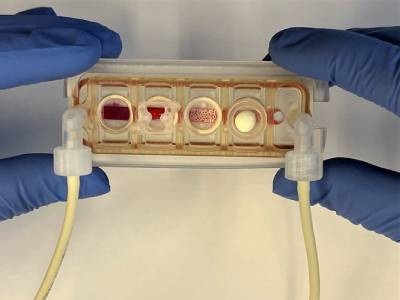
The chip, which is about the size of a microscope slide, includes separate optimized environments for each tissue type: heart, liver, bone and skin. The tissue models are separated from the common vascular flow by a selectively permeable endothelial barrier, and the vascular circulation includes monocytes giving rise to macrophages, which play important roles in directing tissue responses to injury, disease and therapeutic outcomes. The tissues are derived from the same line of human induced pluripotent stem cells (iPSC) obtained from a small blood sample, and are grown and matured for four to six weeks before being linked by vascular perfusion, after which they can be maintained for an additional four weeks.
The researchers demonstrated how the multi-organ model could be used to study the effects of anticancer drugs, and tested doxorubicin on the heart, liver, bone, skin and vasculature. The measured effects of the drug on the tissues recapitulated those reported from clinical studies of cancer therapy using the same drug. The team also developed a novel computational model of the multi-organ chip to perform mathematical simulations of the drug’s absorption, distribution, metabolism and secretion. The model correctly predicted doxorubicin’s metabolism into doxorubicinol as well as its diffusion into the chip.
Combining the multi-organ chip platform with the team’s computational methodology in future pharmacokinetics and pharmacodynamics studies can provide an improved basis for preclinical to clinical extrapolation, with improvements in the drug development pipeline, the researchers said. The ability to create a multi-organ model for a specific patient through a blood sample can also enable personalized optimization of therapy, as disease progression and responses to treatment vary greatly from one person to another. This research was featured as the cover story of the April 2022 issue of Nature Biomedical Engineering.
“After ten years of research on organs-on-chips, we still find it amazing that we can model a patient’s physiology by connecting millimeter sized tissues — the beating heart muscle, the metabolizing liver, and the functioning skin and bone that are grown from the patient’s cells,” said project leader Gordana Vunjak-Novakovic. “We are excited about the potential of this approach. It’s uniquely designed for studies of systemic conditions associated with injury or disease, and will enable us to maintain the biological properties of engineered human tissues along with their communication. One patient at a time, from inflammation to cancer!”
The research team is now using variations of their novel chip to study breast cancer metastasis, prostate cancer metastasis, leukemia, drug safety and effectiveness, and the effects of SARS-CoV-2, radiation and ischemia on human tissue, all in individualized patient-specific contexts. They are also working to develop a user-friendly standardized chip for use in both academic and clinical laboratories.
Photo: The new multi-organ chip has the size of a glass microscope slide and allows the culture of up to four human engineered tissues, whose location and number can be tailored to the question being asked. These tissues are connected by vascular flow, but the presence of a selectively permeable endothelial barrier maintains their tissue-specific niche. Credit: Kacey Ronaldson-Bouchard/Columbia Engineering