High-power continuous wave lasers are used in many applications, including cutting and welding in construction and manufacturing, laser surgery, deep space communications and more. Producing optical components that can withstand the extreme power and heat of these lasers can be a challenge, and even slight imperfections in conventional dielectric mirrors can cause this heat to build up and damage or destroy the mirror. Researchers at Harvard John A. Paulson School of Engineering and Applied Sciences (SEAS) have now proposed a potential alternative to conventional dielectric mirrors, producing a reflective diamond nanostructure that can withstand a 10 kilowatt beam with no damage.
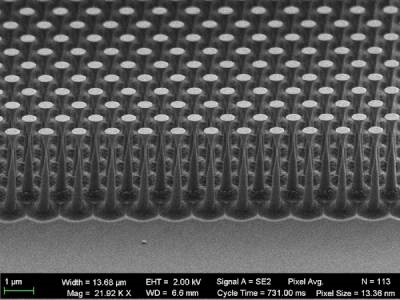
The mirrors designed by the Harvard team consist of a 3 mm by 3 mm diamond sheet with an array of identical golf-tee shaped columns etched onto its surface through the process of reactive-ion beam angled etching. Unlike conventional dielectric mirrors, made from several thin layers of differing materials, the diamond mirrors are monolithic, reducing the chance of defects. The lattice of golf-tee shaped columns gives the diamond surface of reflectivity of up to 98.9% and the inherent properties of the diamond material makes the mirror especially robust.
The diamond mirrors were tested in collaboration with the Pennsylvania State University Applied Research Laboratory, a Department of Defense designated U.S. Navy University Affiliated Research Center, which houses an extremely powerful 10-kilowatt laser. The mirror was irradiated for 30 seconds of continuous wave light from this laser, with the beam focused to a spot measuring 750 µm in diameter. Subsequent optical microscope and scanning electron microscope (SEM) imaging of the diamond mirror showed no apparent damage or change in surface morphology, and the mirror was also found to maintain the same level of reflectivity after the test. A standard dielectric mirror was also tested under the same laser conditions and was shown to rapidly increase in temperature during irradiation, leading to expansion of the dielectric coatings and damage to the mirror. This study was published in Nature Communications.
“Our one-material mirror approach eliminates the thermal stress issues that are detrimental to conventional mirrors, formed by multi-material stacks, when they are irradiated with large optical powers,” said senior author Marko Lončar. “This approach has potential to improve or create new applications of high-power lasers.”
The researchers have filed patents for the technology and are exploring commercialization opportunities. They envision the mirrors could be used for defense applications, deep space communications, semiconductor manufacturing and other manufacturing applications. They also believe their approach to creating monolithic mirrors could be applied to less expensive materials, such as fused silica, to further expand the potential uses.
Photo: Zoomed SEM image of the diamond mirror. Credit: Lončar Lab/Harvard SEAS