Optical coherence tomography (OCT) is a valued technique for obtaining 3D images in medical imaging and other nondestructive testing applications, providing high resolution without requiring any contrast agents or labels. However, OCT still suffers some setbacks, such as a high level of random noise, or speckle, which can obscure biomedically important details, and a limited ability to acquire high-resolution images over a wide field of view in all directions simultaneously. Researchers at Duke University, aiming to unlock the full potential of OCT as a powerful 3D microscopy tool, have developed a new OCT-based imaging method that improves contrast and resolution over a wider 3D field of view using a combination of new hardware and novel algorithms.
To address the limitations of conventional OCT imaging, the researchers developed an optical design that incorporates a parabolic mirror. The parabolic mirror allows the sample to be imaged from multiple views over a very wide range of angles, expanding the 3D field of view. The experimental setup also included a water-filled optical dome placed at the mirror’s focus, where the sample is positioned, in order to mitigate spherical aberrations that can occur with the use of a parabolic mirror, the authors wrote. The team also leveraged machine learning tools to develop an algorithm that effectively uses the many gigabytes of data generated by the system to produce accurate 3D images while correcting for distortions, noise and other imperfections, said research team co-leader Sina Farsiu.
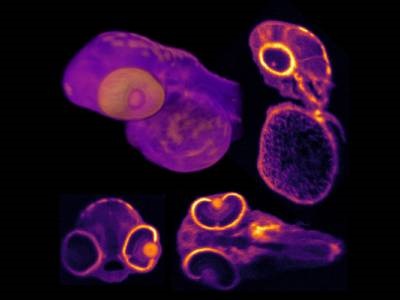
The team demonstrated the capabilities of their technique, called 3D optical coherence refraction tomography (3D OCRT), by imaging various biological samples including zebrafish and fruit flies, as well as mouse tissue samples of the trachea and esophagus. The 3D OCRT system acquired a 3D field of view of up to ±75° without moving the sample, and the improved resolution revealed microscopic details that were not visible using conventional OCT. For example, the optical nerve head and some retinal layers of the eye of a zebrafish larva, which were not apparent using conventional OCT, were revealed using the 3D OCRT system. The results of the study were published in Optica.
“We envision this approach being applied in a wide variety of biomedical imaging applications, such as in vivo diagnostic imaging of the human eye or skin,” said research team co-leader Joseph A. Izatt. “The hardware we designed to perform the technique can also be readily miniaturized into small probes or endoscopes to access the gastrointestinal tract and other parts of the body.”
The researchers are now exploring ways to further miniaturize their system as well as speed it up for live imaging by taking advantage of recent developments in faster OCT system technologies and advances in deep learning that can improve data processing.
Photo: Researchers developed an enhanced version of OCT that can image biomedical samples at higher contrast and resolution over a wider 3D field of view than was previously possible. They used the new approach to image a zebrafish larva. Credit: Kevin Zhou, Duke University