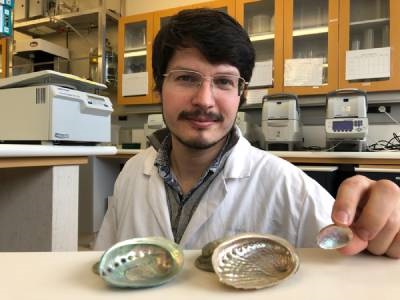
PhD candidate Kerry Walton holds shells from each of the three paua/abalone species from mainland New Zealand. The smallest of the shells, an adult Haliotis virginea (virgin paua), was the focus species of his study. Credit: University of Otago
Mollusk shells are extremely robust and can last in the environment for hundreds or even thousands of years. Countless shell samples in museum collections around the world could be invaluable for researching the evolution of this extremely diverse animal group, but extracting genetic information from these older, dried samples is difficult due to the shells’ calcified, non-cellular structure and low endogenous DNA content. Now, researchers from the University of Otago have developed a minimally destructive extraction method for dry-preserved mollusk shells, which yields more mitogenomic DNA than conventional methods and enables sequencing for phylogenetic analysis.
The researchers analyzed 22 shell samples collected between 1962 and 2020, with 10 samples being preserved in 98% ethanol and 12 being dry-preserved. Most of the shells belonged to the species Haliotis virginea, which is broadly distributed throughout New Zealand and includes several different subspecies. DNA was extracted from the ethanol-preserved samples using a commercially available magnetic-bead-based kit protocol, while the dry-preserved shells underwent a spin-column DNA extraction method requiring just 10-50mg of powdered shell. This spin-column method has previously been used by paleontologists to extract DNA from millenia-old animal bones, but has never previously been applied to DNA extraction from dried mollusk shells. The method is optimized for the recovery of ultra-short fragments and hybridization-capture of single-stranded DNA libraries.
The authors wrote that the extraction methods used yielded high-coverage, near-complete mitogenomes from all samples. The team found that transitioning from a double-stranded to single-stranded approach and adding a hybridisation-capture enrichment step to their protocol yielded about 350 times more mitogenomic DNA from the dried samples. The researchers sequenced the mitogenomes and constructed a maximum likelihood phylogenetic tree and median joining haplotype network map showing the relationships between all 22 samples. The study demonstrates that extraction of mitogenomes from dry-preserved shell samples can be achieved in a minimally destructive manner, requiring smaller amounts of powdered shell than previous extraction methods. This research was published in Molecular Ecology Resources.
“Enabling researchers to use historically collected shells rather than relying on freshly collected specimens would significantly increase the number of specimens and species available for genetic research,” said lead author Kerry Walton. “This would enable, for example, conservation genetic approaches to be applied to endangered or never-before-seen-alive mollusks. A better understanding of invertebrates is critical to understanding soil or water health, and ecosystems as a whole.”
In addition to yielding high-coverage metagenomes without destroying the shell specimens, the method is also relatively affordable compared to other methods. The extraction method could potentially open up hundreds of thousands of shell samples in museum collections for evolutionary research, enabling scientists to track how the genetic diversity of mollusks has changed throughout time, said Walton.