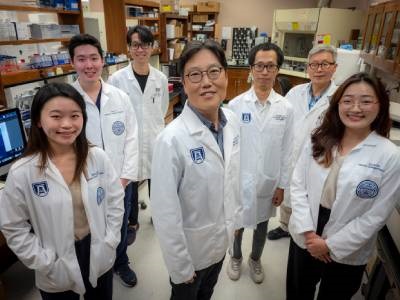
Dr. Sang-Ho Kwon (center) and his research team. Credit: Michael Holahan, Augusta University
Exosomes, vesicles that transport molecules such as proteins and RNA between cells, can provide important information about health and disease based on the types of cargo they contain. Methods for analyzing this cargo, however, typically require the laborious process of exosome isolation, which may yield inconsistent results if exosomes are not properly discriminated from other types of extracellular vesicles. Researchers from the Medical College of Georgia at Augusta University have now developed a system for in situ labeling of exosome cargo proteins, which removes the need for time-consuming exosome preparation methods and specifically detects exosome cargo.
The team’s new labeling system involves an engineered variant of ascorbate peroxidase APEX, which is fused with the protein CD63 to target exosomes. When biotin-phenol and hydrogen peroxide are added, the engineered APEX facilitates a short-term, proximity-dependent biotinylation reaction that provides a specific “snapshot” of exosome cargo proteins, the authors wrote. The biotinylated proteins can then be purified based on streptavidin affinity and analyzed via mass spectrometry for identification. The researchers adapted their approach to both intracellular labeling for developing exosomes in live cells and extracellular labeling for secreted exosomes in conditioned culture medium.
The researchers used their labeling system to analyze proteins in exosomes secreted by live kidney proximal tubule-derived cells in culture, to show how oxidative stress can alter the exosome cargoes from these cells. The team observed several differences between cells that were subjected to oxidative stress and those that were not, including fewer species of biotinylated proteins in stressed cell medium, and an accumulation of ribosomal proteins in exosomes under stressed conditions. The system could thus potentially help detect signs of kidney injury or disease progression in the future by aiding in the analysis of exosomes from patient samples. This research was published in the Journal of Extracellular Vesicles.
“It turns out that by looking at the exosomes in the urine or blood, and by looking at what is inside, we can tell whether the cell is injured or a healthy cell,” said corresponding author Sang-Ho Kwon.
The team hopes to progress testing of their labeling system from cultured kidney cells to animal models of kidney disease. Their technique could also be used to ease the development of databases of exosome contents from various cell types, which will enable comparative studies of how these contents change in different disease states.