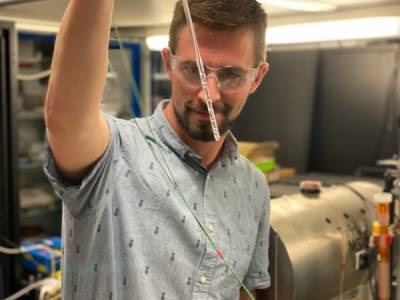
Dr. Danila Barskiy conducting an experiment. Credit: Danila Barskiy
Nuclear magnetic resonance (NMR) is used in a wide range of applications, including medical imaging and chemistry. However, the need to generate powerful magnetic fields using expensive and bulky equipment has limited the scope of its use and presents an obstacle for developing compact and portable NMR devices. Researchers from Johannes Gutenberg University Mainz (JGU) and the Helmholtz Institute Mainz (HIM) have now combined zero- to ultralow-field NMR (ZULF NMR) with an improved hyperpolarization technique that could help minitiarzie NMR analytical tools and expand their use.
ZULF NMR is a recently developed form of NMR spectroscopy that provides abundant analytical results without the need for large magnetic fields. The technique typically uses optically pumped magnetometers as sensors, which are highly sensitive, easy to use and commercially available. Additionally, ZULF NMR signals can be readily detected in the presence of conductive materials such as metals, unlike with traditional high-field NMR. The technique reduces the need for bulky magnets and has the potential to reduce both the size and cost of NMR, but current applications of ZULF NMR still require external polarization before the signal can be detected and are only suitable for the analysis of a limited selection of chemicals.
The JGU and HIM researchers sought to improve the use of ZULF NMR by combining it with a special hyperpolarization technique called Signal Amplification by Reversible Exchange (SABRE). SABRE allows the aligning of nuclear spins at large numbers in solution and relies on an iridium metal complex that mediates the transfer of the spin order from parahydrogen to a substrate. A very recent improvement in the SABRE technique is SABRE-Relay, in which SABRE is used to induce polarization that is then relayed to a secondary substrate. This improvement sidesteps disadvantages resulting from the temporary binding of the sample to the complex. Employing SABRE-Relay in combination with ZULF NMR, the researchers were able to detect the signals for methanol and ethanol extracted from a sample of vodka. This research was published in Science Advances.
“This simple example demonstrates how we have been able to extend the application range of ZULF NMR with the help of an inexpensive, rapid, and versatile method of hyperpolarization,” said study co-author Danila Barskiy. “We hope that we’ve managed to get a little closer to our objective of making feasible the development of compact, portable devices that can be used for the analysis of liquids such as blood and urine and in [the] future, possibly endowing discrimination of particular chemicals such as glucose and amino acids.”