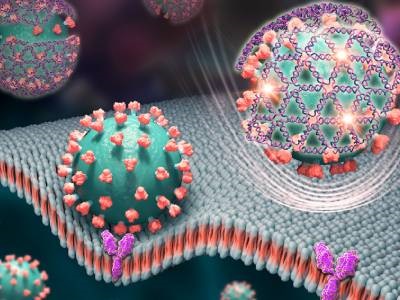
Tiny nets woven from DNA strands cover the spike proteins of the virus that causes COVID-19 and give off a glowing signal in this artist’s rendering. Credit: Xing Wang, University of Illinois
Fast, inexpensive and accurate virus tests aid in the tracking and management of epidemics and pandemics like COVID-19. While polymerase chain reaction (PCR) tests are the gold standard for accurately detecting SARS-CoV-2 genetic material, this method typically takes a day or more to return results and requires the use of sophisticated PCR equipment. Researchers at the University of Illinois Urbana-Champaign, along with collaborators from Louisiana State University and Atom Bioworks Inc., have now developed a sensitive, rapid testing platform based on net-shaped DNA nanostructures; structures that also have potential to inhibit viral infection.
The DNA “net” is designed to envelop and facilitate multivalent binding interactions with spike proteins on the surface of the SARS-CoV-2 virus. This design allows for highly selective, sensitive and rapid detection of SARS-CoV-2 particles that are caught within the “net,” with aptamer nanoswitches allowing fluorescent signals to be released upon interaction between the nanostructure and the virus. These signals can be easily detected using a handheld fluorometer in about 10 minutes. The test can be carried out at room temperature and the researchers estimate a cost of just $1.26 per test. Importantly, the testing platform was able to detect the virus at very low levels (1 × 10³ copies/mL), with equivalent sensitivity to PCR-based tests, and can also detect and differentiate between the active virus and fragments that are no longer infectious, according to the researchers.
The researchers discovered that the DNA net structures also have the potential to inhibit SARS-CoV-2 infection. They performed inhibition assays on live human cell cultures infected with SARS-CoV-2 using different sized DNA nets and found that the structures reduced viral infection, with the antiviral activity increasing with the size of the DNA net scaffold. This demonstrates the potential of DNA nanostructures as novel therapeutic agents. Furthermore, the DNA nets could be customized and tailored to capture other viruses such as influenza and HIV, making them a promising tool for managing other epidemics and future viral outbreaks beyond COVID-19. This research was published in the Journal of the American Chemical Society.
“We’re trying to develop a unified technology that can be used as a plug-and-play platform,” said study leader Xing Wang, a professor of bioengineering and chemistry at the University of Illinois Urbana-Champaign. “We want to take advantage of DNA sensors’ high binding affinity, low limit of detection, low cost and rapid preparation.”