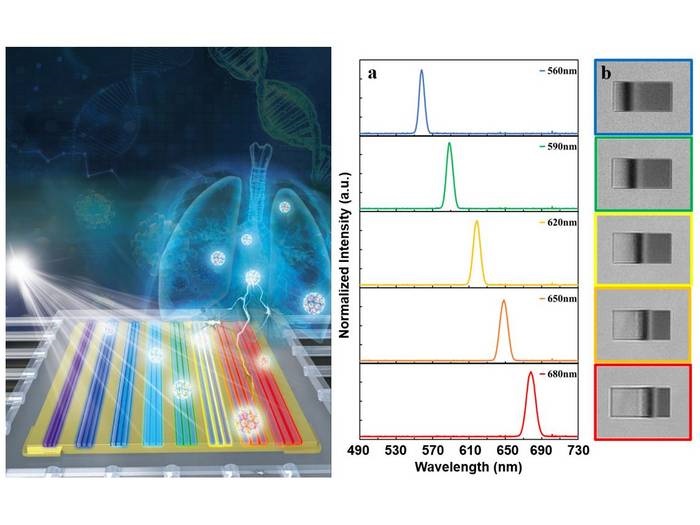
Schematic diagram of the rainbow trapping metasurface used in lung cancer diagnosis (left) and trapped “rainbow” localization images for spectral analysis observed by a 4× objective lens (right). Credit: Qiaoqiang Gan
Health threats such as COVID-19 have highlighted the benefits of rapid, easy-to-use sensing technology that can be utilized for point-of-care or even at-home and wearable diagnostic methods. On-chip sensing technologies offer one avenue for the development of compact, inexpensive and personalized health monitoring devices. New research led by engineers at King Abdullah University of Science and Technology (KAUST) and the State University of New York at Buffalo has made new progress in the area of biosensing metamaterials, showing how the technique of “rainbow trapping” on a chip could enable diagnostics using a simple, inexpensive microscope system.
The “rainbow trapping” system is created from a graded surface nanograting in which the grating period changes from 250 nm to 850 nm, with an average step size of about 5 nm. When the surface is illuminated with LED or laser light, the far-field reflection image reveals a dark region that changes position depending on the incident wavelength. When biomolecules bind to antibodies on the chip, the location of the dark bar shifts, revealing these binding events. The chip surface has an area of just 30 μm × 64 μm, and a microscope with as little as 4x magnification can be used to read the reflection image – this low magnification can be easily achieved using an inexpensive “toy” microscope or smartphone-based microscope system, according to the researchers. Using a 4x objective, the researchers were able to observe wavelength shifts down to 0.032 nm, indicating similar spectroscopic analysis capability to conventional fiber-based or diffraction-grating-based spectrometers, the authors wrote.
The team demonstrated the potential application of the rainbow trapping chip for diagnostic purposes by preparing a 2 x 2 array of sensor units to perform high-throughput sensing of exosomal epidermal growth factor receptor (EGFR), a promising biomarker for lung cancer. Using serum samples from lung cancer patients and healthy controls, the researchers successfully distinguished cancer patients from controls using the sensor array. Because the chip only requires a simple microscopy system for measurement, and can also be cleaned and reused without damaging the nanostructures, according to the researchers, it represents a more cost-effective and easy-to-use sensing system compared to conventional methods. Integrating the chip with smartphone-based microscopy systems in the future could also allow for portable applications, such as point-of-care and at-home diagnostics. This research was published in the journal Engineering.
“Rainbow trapping of light is an intriguing on-chip slow light phenomenon, which was first reported in 2007 based on negative refractive index metamaterials. However, to trap a real rainbow rather than a single wavelength, broadband negative refractive metamaterial is required. This type of material has not been realized to date,” said Qiaoqiang Gan, a professor at KAUST and leading author of the work. “My group demonstrated this fundamentally intriguing phenomenon using graded surface gratings and validated it using experiments. Now, we filled the gap in applications using the trapped ‘rainbow’ chip.”
While the system achieved high resolution using a 4x objective, the researchers noted resolution can still be further improved by using higher magnification, such as 20x. The team is now exploring further implementation of the rainbow chip system for diagnosing different cancers.