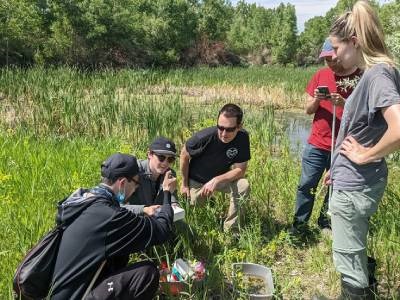
The researchers at a field site in Fort Collins, Colorado collecting mosquitoes for analysis. Credit: Rebekah Kading/Colorado State University
Mosquitos play a large part in the spread in several diseases including West Nile, Zika, dengue and malaria. Tracking the movement of mosquitoes could help scientists and health officials better understand and manage these diseases, but current tracking techniques, such as the use of fluorescent powder, are limited in their reliability and the amount of information that can be gained from them. Now, researchers from Colorado State University (CSU) have proposed a new method to better monitor mosquito populations, using DNA-containing crystals ingested by larvae as barcodes to aid surveillance efforts.
CSU researchers developed the crystal technology over the last several years, engineering the isoprenoid binding protein originally found in Camplyobacter jejuni bacteria to self-assemble into non-toxic crystal structures featuring a highly precise array of pores. The team has explored several potential applications of these crystals, such as for virus particle capture to facilitate wastewater testing, but also found they could easily insert synthetic DNA into the crystals, which remained within the structures even after multiple washes and exposure to solvents. The researchers hypothesized that DNA barcodes incorporated into the crystals could be used to tag mosquitoes through ingestion by mosquito larvae.
The researchers tested this method in 2020 and 2021 at small pilot sites in eastern Fort Collins. They found that the DNA barcodes ingested by larvae persisted in the guts of the mosquitos throughout their adulthood, and could be read after recapture via quantitative PCR (qPCR) or next-generation sequencing (NGS). The barcoded crystals were found to not significantly impact the survival of the adult mosquitos and barcoded individuals were detectable in pools of up to 20 mosquitos, the authors wrote. Because the mosquitos can be tagged in their larval stage, the researchers can track the organisms from where they started to where they ended up, and the use of unique oligonucleotide sequences allows thousands of individual signatures to be included in each batch of mosquitos. In the future, researchers believe they could add a temporal component to the tagging by having mosquito larvae ingest different barcodes every week. This research was published in PNAS Nexus.
“We could have a map on the landscape of mosquitoes being produced in a certain area. We could identify hotspots for mosquito production,” said co-corresponding author Rebekah Kading. “I think this would add a whole other dimension of knowledge to real-time mosquito surveillance and control operations that are already in place.”
The researchers plan to conduct further research using the DNA barcoded protein crystal system, including to investigate why the barcodes persist so well in the mosquito guts and to explore ways to boost the crystals’ performance and improve scalability for potential commercial applications. The team also wants to expand its experiments to tropical environments where mosquito-borne diseases are a more prevalent threat.