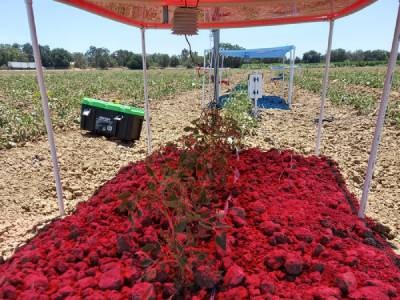
Solar panels emit a red light over tomato plants growing in a research field at UC Davis in 2022. The work further tests the findings of a UC Davis study showing plants in agrivoltaic systems respond best to the red spectrum of light while blue light is better used for energy production. Credit: Andre Daccache/UC Davis
Agrivoltaics, the practice of using the same land for both agriculture and solar power production, has seen growing interest over recent years as a means of reducing emissions, conserving dwindling land resources and tackling other challenges related to climate change and population growth. Growing crops under the shade of solar panels comes with some tradeoffs, however, as some crops may see lower yield when grown in this condition; thus, optimizing agrivoltaic systems to make them more efficient and more profitable could expand their applications and provide greater environmental and land management benefits. Researchers from the University of California, Davis, have uncovered insights that could help improve these systems, showing that harnessing specific segments of the spectrum of sunlight could improve efficiency in both crop growth and solar energy production.
For their study, the researchers developed a photosynthesis and transpiration model accounting for different light spectra from the sun. The model reproduced how various plants responded to the different spectra under controlled conditions, including lettuce, basil and strawberry plants. The researchers used the model to conduct a sensitivity analysis that measured responses, including photosynthetic rate, transpiration and water use efficiency, both to different incident light spectra and to other conditions like temperature, humidity and atmospheric CO2 concentration. Through this analysis, the team could determine which part of the light spectrum was most conducive to plant growth in varying conditions.
The analysis showed that red light was the most efficient in supporting plant growth through improved photosynthetic rates and water use efficiency compared to other spectra. Blue light was found to be less beneficial for plant growth and could be more efficiently used for producing solar energy. Currently, solar panels take in the full spectrum of light while crops in agrivoltaic systems grow under complete or partial shading from these opaque panels; however, new generation semi-transparent photovoltaics could potentially be used to harvest specific segments of light spectra, using blue light to generate power while passing red light to the plants. Such a system could make agrivoltaics more beneficial by making more efficient use of the sun’s rays. This study was published in the journal Earth’s Future.
“We cannot feed 2 billion more people in 30 years by being just a little more water-efficient and continuing as we do,” said corresponding author Majdi Abou Najm. “We need something transformative, not incremental. If we treat the sun as a resource, we can work with shade and generate electricity while producing crops underneath. Kilowatt hours become a secondary crop you can harvest.”
This past summer, the team conducted further testing on the use of different light spectra to grow tomato plants at UC Davis agricultural research fields. Because plants’ responses to different light spectra vary based on plant species and other environmental conditions, further testing is needed to assess the use of this agrivoltaics approach on various crops and in areas with different climates.