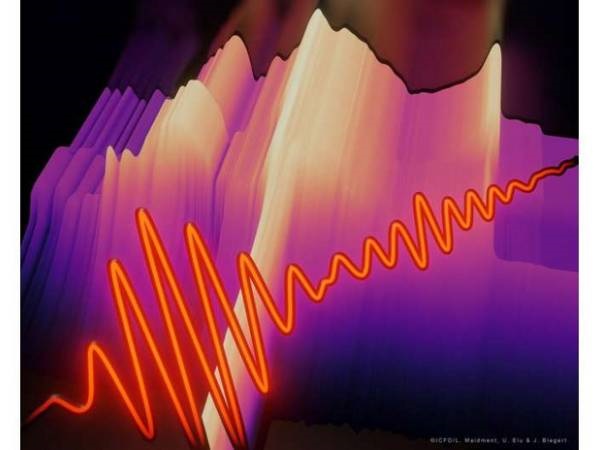
Bright light source covers seven optical octaves. Credit: ICFO - The Institute of Photonic Sciences
Spectroscopy encompasses a range of analytical techniques with nearly countless applications across a wide variety of scientific fields; different wavelengths of light – such as infrared (IR), ultraviolet (UV) or visible light – can be used to probe molecules in different ways, with some wavelength ranges being better suited for specific applications than others. A typical laboratory spectrometer offers a limited wavelength range, which is dependent on the light source it uses, and expanding this range may require multiple instruments or the use of large facilities to house especially complex sources. Now, researchers from The Institute of Photonic Sciences (ICFO) have developed an extremely broadband, very bright coherent light source that spans seven optical octaves – from UV to terahertz (THz) wavelengths – in one tabletop instrument.
In order to create a light source spanning a broad swath of the electromagnetic spectrum, without the need for mechanical tuning or synchronizing of numerous narrow spectrum sources, the researchers leveraged a combination of three nonlinear techniques. First, soliton self-compression and dispersive wave generation in an anti-resonant-reflection photonic crystal fiber are used to achieve a very short pulse of 3.5 femtoseconds, and an extreme supercontinuum of 340 to 6000 nm. Then, intrapulse difference frequency generation is applied, which broadens the output spectrum to 40,000 nm, for a complete wavelength range from 340 to 40,000 nm. Additionally, the source features a spectral brightness of up to five orders of magnitude higher than synchrotron sources, according to the researchers.
The spectral intensity of the source can be tuned by changing the soliton self-compression pressure – for example, pressures above 25 bar provide a bright UV output between 340 to 360 nm, the authors found. The researchers demonstrated UV peak powers up to 2.5 MW, and THz peak powers of 1.8 MW. With the ability to generate wavelengths spanning seven octaves using a single source, the technology could enable a wide variety of strong field, ultrafast molecular spectroscopy applications, such as the simultaneous, highly precise identification of toxic molecular compounds in pharmaceuticals, or research into the origins of high-temperature superconductivity. This research was recently presented by co-author Lenard Vamos, Ph.D., at the Optica Laser Congress held Dec. 11-15, 2022 in Barcelona, Spain.
“The combined coherent spectral bandwidth and high brightness allow to implement new hyperspectral ultrafast spectroscopies without timing jitter,” said Vamos. “This will allow to pump and probe charge and nuclear dynamics in atoms, molecules, liquids and solids with unprecedented precision.”
The ICFO team is currently using the light source to optically probe nonlinear signatures of quantum phase transitions in quantum materials such as a high-Tc superconductor, explained Vamos. This application has so far demonstrated the ability of the source to directly identify various quantum properties in complex materials, Vamos added.