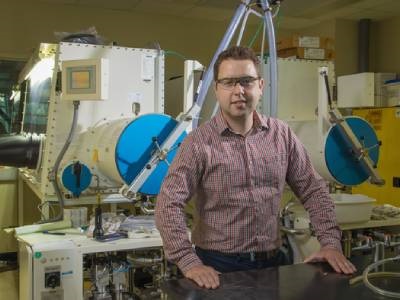
Caleb D. Martin, Ph.D., associate professor of Chemistry at Baylor University, Waco, TX. Credit: Matthew Minard, Baylor University
Lewis acids are used as activators in the production of polyolefin plastics, reacting with zirconium or hafnium compounds to enable the polymerization of olefins. Methods for synthesizing strong Lewis acids are time-consuming and involve many steps, and require the use of fluorinated compounds that can pollute and persist in the environment. Researchers at Baylor University have now produced a new halogen-free Lewis superacid that can be synthesized in one step using three commercially available chemicals.
The new compound, known as tris(ortho-carboranyl)borane (BoCb3) was developed by a team led by Caleb D. Marin, an associate professor in the Department of Chemistry and Biochemistry at Baylor. Martin said the idea to produce the new compound came after he inherited chemicals from the lab of late Baylor chemist F. Gordon A. Stone following Stone’s retirement, a collection that included the compound ortho-carborane. In 1963, Stone produced the strong Lewis acid tris(pentafluorophenyl)borane, or B(C6F5)3, that is currently still used in the production of polyolefins. Martin’s team sought to improve on Stone’s work and produce a stronger Lewis acid, leveraging the unique properties of ortho-carborane, including its strong electron withdrawing effect.
Ultimately, the team developed a one-pot synthesis method requiring only three chemicals: ortho-carborane, n-Butyllithium (n-BuLi) and boron tribromide (BBr3). The resulting compound, BoCb3, showed high fluoride and hydride ion affinities in theoretical binding studies, and was found to have greater Lewis acidity than other strong Lewis acids, including B(C6F5)3, making it a rare Lewis superacid, the authors wrote. These properties make BoCb3 a promising compound for polyolefin production, and the simple, efficient synthesis method could make it a time- and cost-saving alternative to other Lewis acids. Additionally, because BoCb3 is halogen-free and requires less waste to produce, it is more environmentally friendly than its counterparts, the researchers said. This research was published in Angewandte Chemie.
“We make new compounds all the time. However, it’s rare to come up with a unique, useful compound from just three things that you can order from a catalogue,” said Martin. “Although it is too soon to know the full impact of BoCb3, it’s very easy to envision this technology will be really attractive to the petroleum industry.”
The Baylor team has filed a provisional patent and is now working extensively with three academic research groups in California, Germany and Italy to further study the extent of the new compound’s reactivity and potential commercial applications.