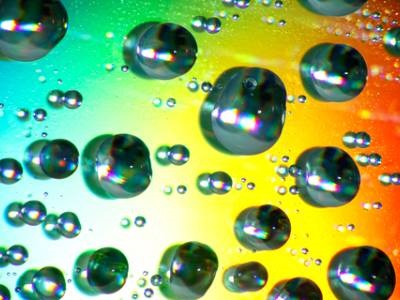
Liquid microdroplet lasers offer a number of benefits including flexibility, wide tunability and the potential to reduce the size and costs of some laser technologies. However, droplet lasers are unstable under ambient conditions and must be operated in a specialized container or matrix to prevent evaporation, limiting their application in everyday settings. Researchers from the University of Tsukuba have developed a new type of microdroplet laser with increased stability under ambient conditions, which can be reversibly tuned with a flow of gas and scaled using available inkjet printing technology.
The researchers took inspiration for their laser system from the surface of lotus leaves, whose microscale morphology causes water droplets to form near-perfect spheres.The team first selected the ionic liquid 1-ethyl-3-methylimidazolium tetrafluoroborate (EMIBF4) as the liquid medium for the droplets due to its very slow evaporation rate and high surface tension. The EMIBF4 was combined with a dye lasing medium and the droplets were deposited on a quartz substrate coated with hydrophobic fluorinated silica nanoparticles, which mimics the surface of lotus leaves. The researchers found that microdroplets pipetted onto the quartz surface remained almost completely spherical. Additionally, the droplets remained stable for at least 30 days under ambient conditions. Mathematical calculators predicted the droplets would maintain their desired morphological and optical properties, even when exposed to gas convection, said first author Hiroshi Yamagishi.
The spherical shape of the droplets and their resistance against evaporation allowed them to maintain an optical resonance when excited with a laser pumping source. The team found the wavelength of the laser could be tuned between 645 to 662 nm by slightly changing its shape with “faint breeze” of nitrogen gas or exposure to moisture. Due to this property, the microdroplet laser could also be used as a very sensitive humidity or airflow detector. The liquid laser system is also highly scalable, as the researchers were able to use a commercial inkjet printing apparatus, equipped with a printer head designed for viscous liquids, to deposit several droplets on the substrate without the need for further treatment. This research was published in Laser & Photonics Reviews.
“This is, to our knowledge, the first liquid laser oscillator that is reversibly tunable by the gas convections,” said Yamagishi.
The ease and scalability of EMIBF4 microdroplet production could lead to the development of inexpensive sensors or optical communication devices, the researchers said. The high stability of the droplet system compared to similar systems could ultimately expand the use of liquid lasers beyond specialized settings.