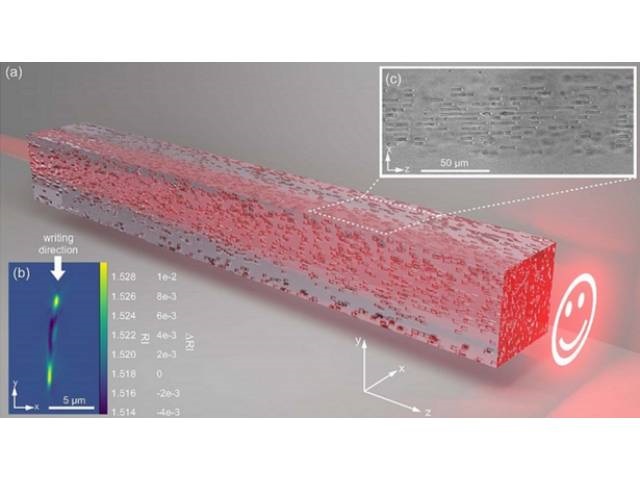
The intensity shaper can convert an input Gaussian beam to precisely direct light, as in (a) “smiley” light distribution. Precision arrangement of voxels is achieved using ultrafast direct laser writing. (c) Each voxel is a micron-sized element with (b) a specific refractive index profile along the x and y axes. Credit: Barré et al., doi 10.1117/1.APN.2.3.036006
The ability to shape light in three dimensions is a key factor in advancing technologies such as optical computing and digital holography. Aperiodic photonic volume elements (APVEs), which are composed of microscopic voxels with specific refractive indices, have the potential to serve as integrated 3D beam shapers in photonic devices, but suffer from limitations such as low diffraction efficiencies that severely degrade the beam output. In an effort to improve the performance and applicability of APVEs, researchers from the Medical University of Innsbruck, University of Erlangen-Nuremberg and University of Oxford have developed an optimized approach to APVE design and fabrication, producing APVEs from borosilicate glass with unprecedented diffraction efficiencies.
To produce the highly precise and efficient APVEs, the researchers optimized both the design algorithm and the fabrication method used to shape the borosilicate glass substrate. The algorithm is based on numerical beam propagation, which simulates the propagation of light through the glass medium in order to calculate the optimal placement of voxels to achieve the desired shaping effect. The APVEs were fabricated using a femtosecond direct laser writing method incorporating dynamic wavefront control in order to compensate for spherical aberration. This compensation ensured that the voxel profile remained consistent at various depths throughout the medium. The team produced three different types of APVEs using this approach: an intensity shaper, an RGB multiplexer and a Hermite-Gaussian (HG) mode sorter.
Each APVE produced was just millimeters in length, containing between 154,000 and 308,000 voxels occupying a volume of about 1.75 µm × 7.5 µm × 10 µm each. The fabrication method was fast, taking just 20 minutes to produce each element. As a proof of concept, the team produced an intensity shaper and RGB multiplexer capable of shaping Gaussian beams into smiley face designs. The intensity shaper output the smiley design with a diffraction efficiency of 80%, a record-breaking efficiency for APVEs. The RGB multiplexer produced smiley faces with a red outline, green eyes and blue mouth, also with relatively high total efficiencies up to 55%. To demonstrate the capabilities of the mode-sorting APVE, the researchers designed an element capable of converting six Gaussian inputs from optical fibers into corresponding HG outputs. While the HG mode sorter was the least efficient of the APVE prototypes, the authors noted that improvements, such as the use of a gradient index design, could build upon the capabilities of similar APVEs in the future. This research was published in Advanced Photonics Nexus.
“The flexibility of our method could make it viable for designing a wide range of 3D devices for applications in information transport, optical computing, multimode fiber imaging, nonlinear photonics, and quantum optics,” said corresponding author Alexander Jesacher, of the Medical University of Innsbruck.
The researchers also noted that, in addition to its simplicity and low cost, their high-precision approach to APVE fabrication could potentially be extended to other substrates, including nonlinear materials.