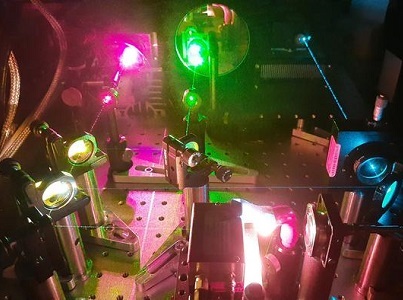
Credit: Henning Ortkrass, Bielefeld University
Researchers have developed a fluorescence microscope that uses structured illumination for fast super-resolution imaging over a wide field of view. The new microscope was designed to image multiple living cells simultaneously with a very high resolution to study the effects of various drugs and mixtures of drugs on the body.
The innovation is based on super-resolved structured illumination microscopy (SR-SIM), which uses a structured pattern of light to excite fluorescence in a sample and achieve a spatial resolution beyond the diffraction limit of light. SR-SIM is particularly well suited for live cell imaging because it uses low-power excitation that doesn’t harm the sample while producing highly detailed images.
To achieve high resolution across a wide field of view, the microscope reconstructs super-resolved images from a set of raw images. These raw images are acquired by using a set of six optical fibers to illuminate the sample with a sinusoidal striped pattern that is shifted and rotated to gain extra information. This creates a two-fold resolution improvement while still achieving fast imaging and being compatible with live-cell imaging.
The researchers tested their new setup in experiments using samples of fixed multicolor-stained rat liver cells. The reconstructed images produced with the new microscope allowed visualization of the tiny membrane structures that are smaller than the diffraction limit of light.
“This compact system uniquely combines a large field of view and fast pattern switching speed with multicolor, power-efficient excitation,” said Henning Ortkrass, professor at Bielefeld University (Germany). “In addition, the setup achieves very high image quality and can be tuned to perform either 2D-SIM or TIRF-SIM.”
Next, the researchers plan to apply the microscopy setup to live cell studies of liver cells to observe the dynamics of cells treated with several drugs. They also plan to improve the image reconstruction process to accomplish live reconstruction of the acquired raw data.