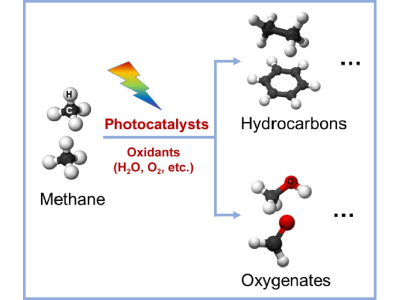
Credit: Youxun Xu et al.
Researchers have published their findings on recent advances in the use of photocatalysis for methane conversion to other high-value commodities such as fuel or chemicals. Traditional methods of conversion involve high energy consumption along with releasing large amounts of CO2, photocatalysis is a promising alternative to reduce emissions and energy consumption.
Currently, methane conversion is an indirect reaction utilizing synthesis gas due to methane's inert properties. This conversion, which is often used to create valuable fuels or chemicals, requires large amounts of energy and subsequently releases CO2. "The shift to methane conversion by net-zero carbon dioxide emissions is a critical task for both scientific research and industry, as it will produce high-value chemicals without potentially catastrophic consequences," said Junwang Tang, a professor at University College London.
Methane is found abundantly throughout the world and has a high caloric value, making it appealing for use as an energy source for power production and residential heating. However, methane has a significantly higher global warming potency than carbon dioxide making the need for a greener methane conversion method of utmost importance.
Current thermal catalysis methods require high reaction temperatures in excess of 400°C along with costly oxidants. Modern photocatalysis conversion methods are possible using only sunlight or artificial light and use oxidants such as water or oxygen for the conversion. Photocatalysis is capable of selectively oxidizing methane to C2+ hydrocarbons or oxygenates in a much greener way.
Despite this, photocatalysis does have its drawbacks. One such drawback, as noted in the study published in Carbon Future, is the relatively low yield of high-value products. "Additionally, greater attention should be paid to higher value products, which remains a significant challenge in this field," said Tang.
The team plans to continue their research with the ultimate goal of increasing the conversion rate and converting methane into more high-value products by optimizing the reaction system. "Our ultimate goal is to produce the seven most basic chemicals by photocatalytic methane conversion," said Tang.