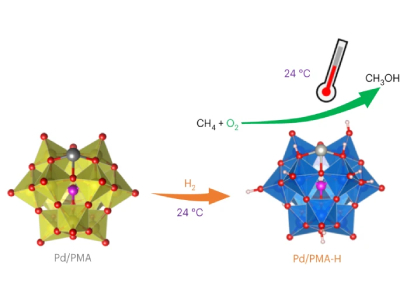
Credit: Sikai Wang et al.
Cardiff University scientists have developed a more sustainable method of methanol production that can be used to create methanol at room temperature. The new catalytic method does not require external energy sources and presents a greener methanol production method than currently used.
The study, published in Nature Catalysis, outlines the new room temperature catalytic method which, with some further development, could scale for industrial applications. The discovery stems from efforts made by the researchers at Cardiff to move from energy-intensive processes to more sustainable catalysis technology.
"Identifying new and effective catalysts for methanol synthesis from methane is of crucial importance to provide new pathways for the modern chemical industry," said Graham Hutchings, Professor of Chemistry at Cardiff University.
The research comes as a result of an international collaboration led by researchers at the newly formed Net Zero Innovation Institute at Cardiff University. The Net Zero Innovation Institute has extensive expertise in catalyst design and characterization and plans to continue its focus on developing new catalytic methods for industry applications to promote sustainable technology.
"The discovery may be a significant step towards a sustainable methanol-based fuel economy, using abundant methane as the feedstock,” said Dr. Andrea Folli, University Research Fellow in Electrocatalysis at the Net Zero Innovation Institute. "The global warming potential of methane is 25 times the one of carbon dioxide so this is a crucial step in achieving net zero by 2050."