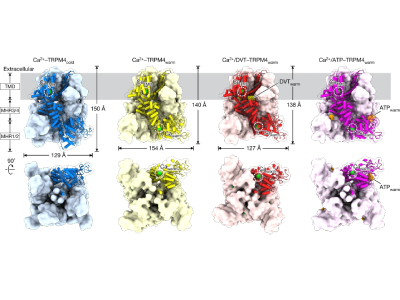
The overall structures of TRPM4cold bound to Ca2+ and TRPM4warm bound to Ca2+, Ca2+ and DVT, or Ca2+ and ATP. Credit: Jinhong Hu et al.
New research from the Van Andel Institute has revealed that certain proteins modify their shape when exposed to various temperatures. The findings reveal previously unknown potential binding sites for medications.
The findings, published in Nature, could potentially revolutionize our understanding of biological processes. Currently, proteins are most commonly studied at low temperatures to ensure their stability. However, the novel findings of the research demonstrate that certain proteins are temperature-sensitive and could change the way future drug discovery researchers investigate protein binding sites.
"For a long time, the methods we've used to study proteins require them to be cold or frozen. But in the real world, human proteins exist and function at body temperature," said Juan Du. "Our study describes a new way to study proteins at body temperature and reveals that some proteins drastically alter their structures when warm, opening up new opportunities for structure-guided drug development."
While it is well established that temperature can affect molecular functions, studying proteins at physiologically relevant temperatures has proven difficult. To overcome these challenges the researchers leveraged cryo-electron microscopes (cryo-EM) which allowed them to flash-freeze proteins and achieve highly detailed images of their structures. By heating the proteins to body temperature before flash freezing and imaging, the team discovered that ligands interact with different sites at body temperature versus lower temperatures.
The study's findings are impactful for several industries, particularly those involved with drug discovery and development, and reinforce the need to study proteins at body temperature. By investigating proteins at body temperature, researchers can identify novel physiologically relevant targets for drug-binding sites.