Credit: Hao Li et al
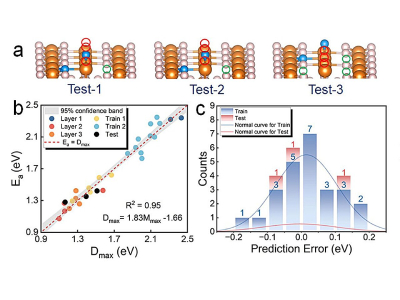
Tohoku University researchers have developed a novel data-driven model to predict the dehydrogenation barriers of solid-state hydrogen storage materials. Solid-state hydrogen storage materials are currently a prime candidate for high-capacity hydrogen energy storage.
The model, published in Angewandte Chemie International Edition, can rapidly predict the dehydrogenation barriers of magnesium hydride (MgH2), a promising solid-state hydrogen storage material. Traditional transition state analysis techniques are costly and time-consuming, hindering the pace at which these solid-state materials can be discovered and optimized. Despite nearly five decades of research, the material properties of MgH2 have yet to meet the targets set by the US Department of Energy.
To address these issues, the team developed a data-driven model to predict dehydrogenation barriers using the crystal Hamilton population orbital of the Mg–H bond as well as the distance between atomic hydrogen atoms. By analyzing the distance-energy ratio, the model can capture the essential chemistry of the reaction with much less required computational energy than traditional methods.
"Our model offers a faster, more efficient way to predict the dehydrogenation performance of hydrogen storage materials," said Hao Li, associate professor at Tohoku University's Advanced Institute for Materials Research (WPI-AIMR). "This allows us to bridge the knowledge gap left by experimental techniques and accelerate the development of high-performance hydrogen storage solutions."
The findings will not only aid in driving MgH2 closer to DOE guidelines but could have broader applications in other metal hydrides as well. The team intends to expand the model beyond magnesium-based materials, potentially allowing for the discovery of new composite materials and novel solid-state hydrogen storage technologies.
"By adapting our model to various metal hydrides, we can expedite the exploration and optimization of hydrogen storage materials, paving the way for cleaner and more efficient energy systems," said Li.