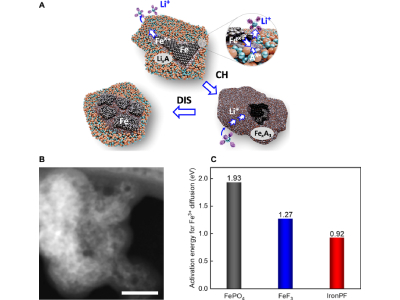
Ion transport for the LSC cathode. Credit: Mingliang Yu et al.
Oregon State University researchers have published their findings demonstrating the efficacy of replacing cobalt and nickel with iron as a cathode material in lithium-ion batteries. The advancement could increase energy density while significantly reducing production costs.
In most modern lithium-ion batteries, nickel and cobalt are the standard metals used to manufacture battery cathodes. Recent increases in battery production have led to an unsustainable demand for nickel and cobalt, leading experts to predict shortages in a matter of decades. Additionally, the energy density of these materials has already been pushed to its limit.
In the study, published in Science Advances, the researchers have developed a novel cathode that would provide drastic reductions in manufacturing costs while providing a more sustainable cathode production method.
“We’ve transformed the reactivity of iron metal, the cheapest metal commodity,” said Xiulei “David” Ji. “Our electrode can offer a higher energy density than the state-of-the-art cathode materials in electric vehicles. And since we use iron, whose cost can be less than a dollar per kilogram – a small fraction of nickel and cobalt, which are indispensable in current high-energy lithium-ion batteries – the cost of our batteries is potentially much lower.”
To manufacture the cathodes, the team increased the reactivity of iron by adding fluorine and phosphate anions. “We’ve demonstrated that the materials design with anions can break the ceiling of energy density for batteries that are more sustainable and cost less,” Ji said. “We’re not using some more expensive salt in conjunction with iron – just those the battery industry has been using and then iron powder. To put this new cathode in applications, one needs to change nothing else – no new anodes, no new production lines, no new design of the battery. We are just replacing one thing, the cathode.”
The researchers believe that after improvements to the battery's storage efficiency, the resulting batteries will be more efficient and greener with lower production costs than current state-of-the-art batteries.