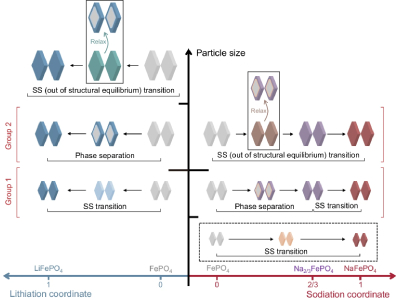
Schematic illustrations depicting the particle size dependent phase evolutions of olivine FePO4 particles during lithiation or sodiation. Credit: Gangbin Yan et al.
University of Chicago researchers have developed a novel method for extracting lithium from widespread sources such as seawater and groundwater. The optimized method could aid in filling global lithium demands.
Global lithium production has more than tripled in the last decade thanks to growing demand to supply lithium-ion battery producers. However, current lithium extraction methods from rock ores require large amounts of energy and come with environmental impacts. Additionally, current methods are time-consuming and require sources of highly concentrated lithium.
"Right now there is a gap between the demand for lithium and the production," said Chong Liu, Assistant Professor of Molecular Engineering. "Our method allows the efficient extraction of the mineral from very dilute liquids, which can greatly broaden the potential sources of lithium."
The method, published in Nature Communications, relies on the electrochemical properties of lithium to allow for its extraction from dilute sources. The method uses crystal lattices of olivine iron phosphate, which because of its size, charge, and reactivity, lithium is drawn into the spaces in the olivine iron phosphate columns. When designed perfectly, the columns can also filter out sodium ions or reduce them to a much lower concentration.
During optimization, the team produced iron phosphate particles in a range of particle sizes from 20 to 6,000 nanometers. They found that when the particles were too large or too small, more sodium was let in resulting in less pure lithium extractions. "It turned out that there was this sweet spot in the middle where both the kinetics and the thermodynamics favor lithium over sodium," said Liu.
The findings suggest that to commercialize the method, the team will need to produce the olivine iron phosphate at an ideal particle size to optimize the pure lithium extraction. "We have to keep this desired particle size in mind as we pick synthesis methods to scale up," Liu said. "But if we can do this, we think we can develop a method that reduces the environmental impact of lithium production and secures the lithium supply in this country."