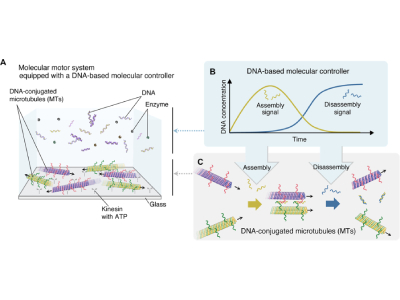
Concept and mechanisms of an autonomous molecular system. Credit: Ibuki Kawamata et al.
Tohoku University and Kyoto University researchers have developed a DNA-based molecular controller capable of autonomously directing the assembly and disassembly of molecular robots. The tech represents a significant leap forward in the development of autonomous molecular systems.
"Our newly developed molecular controller, composed of artificially designed DNA molecules and enzymes, coexists with molecular robots and controls them by outputting specific DNA molecules," said Shin-ichiro M. Nomura, an associate professor at Tohoku University, when discussing the research published in Science Advances.
Previously, the researchers developed swarm-type molecular robots that could be assembled or disassembled as a group through external manipulation. But thanks to the molecular controller developed, these molecular robots can now self-assemble or disassemble following a programmed sequence. As a result of this assembly, molecular robots can now assemble according to pre-set commands and then disperse to explore various targets.
"By developing the molecular controller and combining it with increasingly sophisticated and precise DNA circuits, molecular information amplification devices, and biomolecular design technologies, we expect swarm molecular robots to process a more diverse range of biomolecular information automatically," added Nomura.
"This advancement may lead to the realization of innovative technologies in nanotechnology and the medical field, such as nanomachines for in-situ molecular recognition and diagnosis or smart drug delivery systems."