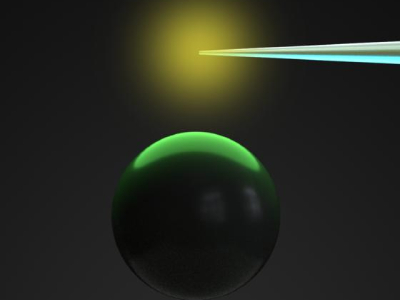
Credit: Inoue Lab at Johns Hopkins Medical Institute, created by Shiva Razavi and Turhan Pathan.
Scientists at Johns Hopkins Medicine have developed a synthetic cell that demonstrates “symmetry breaking” following an external cue. The findings lay the groundwork for developing a synthetic cell capable of moving toward a desired target.
symmetry breaking is a step that precedes cell movement in which the molecules of a cell reorganize into an asymmetrical pattern. During this process cells are transformed into polarized structures that aid in traversing blood vessel walls to reach infected tissue.
“The notion of symmetry breaking is crucial to life, impacting fields as diverse as biology, physics and cosmology,” said Shiva Razavi, who led the research as a graduate student at Johns Hopkins. “Understanding how symmetry breaking works is key to unlocking the fundamentals of biology and discovering how to harness this information to devise therapeutics.”
In the study, published in Science Advances, the researchers developed a large vesicle with chemical-sensing capabilities that prompted the cell to break symmetry. To activate the cell, the team employed FKBP and FRB to act as molecular switches and once activated the reaction of these proteins resulted in a rod-like structure composed of acting bending the cell membrane.
“Our study demonstrates how a cell-like entity can sense the direction of an external chemical cue, mimicking the conditions you would find in a living organism,” added Razavi. “By building a cell-like structure from scratch, we can better identify and understand the essential components required for a cell to break symmetry in its most simplified form.”
The researchers intend to expand on the capabilities of the cell to include moving toward a desired target, with the ultimate goal of engineering synthetic cells that can be used for targeted drug delivery, and other applications that rely on precise movement or response to stimuli.