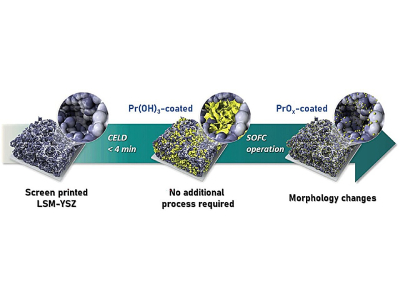
Illustrations of the electrochemical coating process on LSM–YSZ electrode of SOFCs. Credit: Korea Institute of Energy Research (KIER)
A novel discovery from researchers at the Korea Institute of Energy Research and the Pusan National University could improve the performance of solid oxide fuel cells in just four minutes. Solid oxide fuel cells (SOFCs) are currently the main driver of the hydrogen economy, thanks to their high power generation efficiency.
SOFC performance is primarily determined by the kinetics of the oxygen reduction reaction occurring at their air electrode. The reaction rate at this electrode, however, is slower than that of the fuel electrode limiting the reaction rate of the device. To combat this the researchers devised a method to apply nanoscale praseodymium oxide catalysts to the surface of the composite electrode which promotes the oxygen reduction reaction.
The method, published in Advanced Materials, operates at room temperature and atmospheric pressure to uniformly coat the electrode. After coating, the layer is dried forming a stable oxide that promotes the oxygen reduction reaction in high-temperature environments. The entire coating and drying process takes only four minutes and provides a peak power density three times higher than uncoated cells.
"The electrochemical deposition technique we developed is a post process that does not significantly impact the existing manufacturing process of SOFCs," said Dr. Yoonseok Choi from the Korea Institute of Energy Research (KIER). "This makes it economically viable for introducing oxide nano-catalysts, enhancing its industrial applicability."
While SOFCs are the main focus of the study, the method could be utilized in other energy conversion sectors. "We have secured a core technology that can be applied not only to SOFCs but also to various energy conversion devices, such as high-temperature electrolysis (SOEC) for hydrogen production," added Dr. Choi.