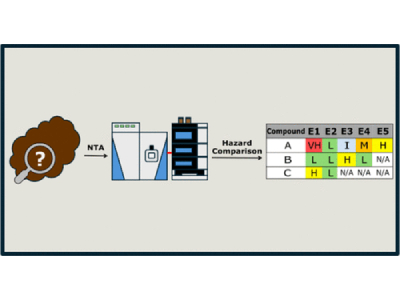
Credit: Matthew N. Newmeyer et al.
New research from Johns Hopkins University introduces concerns over hazardous organic chemicals found in wastewater-based fertilizers. The research offers the most comprehensive analysis of biosolids and highlights the potential need for regulation of chemical contaminants contained within them.
The research, published in Environmental Science & Technology, provides a comprehensive analysis of fertilizers manufactured from the sludgy leftovers of wastewater treatment.
“We’ve been relatively in the dark when it comes to possible organic hazards in biosolids, and we need to know if there are any smoking guns that we’re unaware of,” said Carsten Prasse, an assistant professor in the Department of Environmental Health and Engineering. “Regulators need to know what these types of fertilizers are made of to determine how they can be responsibly used.”
Utilizing analytical chemistry techniques, the team analyzed 16 samples of biosolids from wastewater facilities in nine U.S. cities as well as three Canadian cities. The researchers discovered 92 compounds that were present in 80% or more of the samples, among these contaminants, was bisphenol A (BPA).
“We’re not saying that these compounds pose a risk right now, because we haven’t done a formal risk assessment,” said Matthew Newmeyer, a research associate at the Bloomberg School of Public Health. “We’re saying that these have a potential to be problematic and we need more information in order to make sure these biosolids are safe.”
According to the EPA, more than half of the 3.76 million tons of biosolids produced in 2022 were used to fertilize agricultural lands, golf courses, and other landscaped areas. While direct contact with these biosolids is likely limited, the general public could be exposed through contaminants absorbed by crops.
The researchers intend to expand on their findings to measure the identified compounds in vegetables grown in biosolid-amended soil. Additionally, they are investigating risks to farmers and other individuals who work with the biosolids.